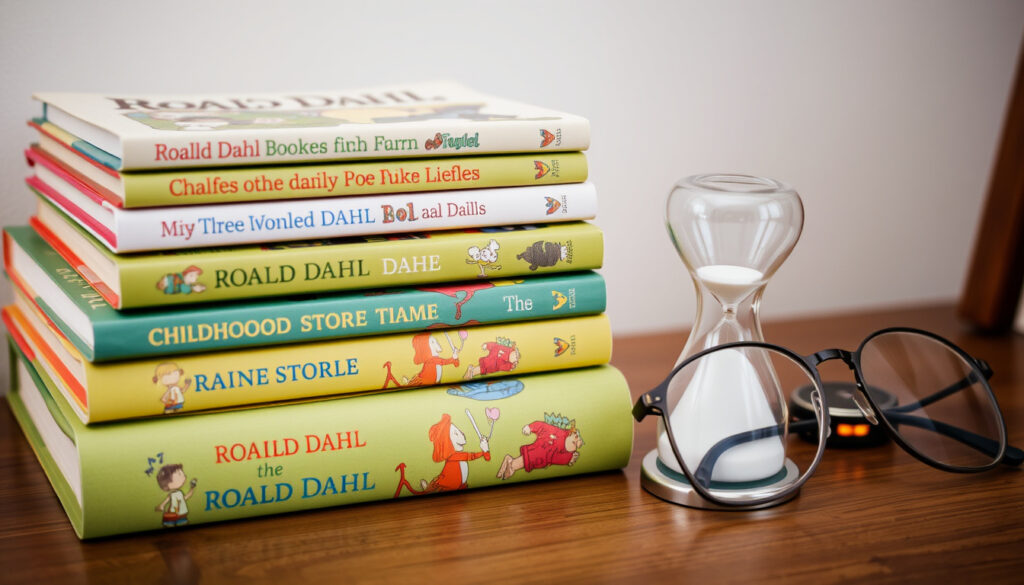
Roald Dahl Books in Order: Complete Age Guide
There’s a reason Roald Dahl’s stories have stuck around for decades — they treat children like clever, brave little people, not delicate flowers. Whether it’s Matilda outsmarting her parents or Charlie finding a Golden Ticket, these books feel like secret handshakes between the author and the reader.
Total children’s books published: 19 ·
Best-selling title: Charlie and the Chocolate Factory ·
Year of first publication: 1943 ·
Year of last publication: 1990 ·
Estimated global sales: 250 million+ copies
Quick snapshot
- Roald Dahl wrote 19 children’s novels (Wikipedia – Roald Dahl bibliography)
- Charlie and the Chocolate Factory is his best-selling book (Wikipedia – Roald Dahl bibliography)
- Matilda was published in 1988 (Wikipedia – Roald Dahl bibliography)
- Exact global sales figures for individual books beyond Charlie and the Chocolate Factory
- Detailed reading level breakdowns beyond age recommendations provided by publishers
- Whether the total count of 19 children’s novels includes all posthumous releases
- First children’s book: The Gremlins (1943) (Roald Dahl Museum – published works timeline)
- Final book in his lifetime: Esio Trot (1990) (Wikipedia – Roald Dahl bibliography)
- New generations continue discovering Dahl through film adaptations and stage productions
- Complete box sets make it easy to read through the entire collection in order
Five key stats capture the scale of Dahl’s legacy in children’s literature.
| Attribute | Value |
|---|---|
| Total children’s books published | 19 novels plus picture books |
| Best-selling title | Charlie and the Chocolate Factory |
| First children’s book | The Gremlins (1943) |
| Last children’s book published in his lifetime | Esio Trot (1990) |
| Estimated global sales | Over 250 million copies |
What are some of Roald Dahl’s most famous books?
Five titles dominate nearly every list of Dahl’s best works, and each has been adapted into a film or stage production. The Wikipedia bibliography (community-edited reference) confirms these as his most widely recognised books.
- Matilda (1988) — the story of a gifted girl with telekinetic powers who takes on her tyrannical headmistress.
- Charlie and the Chocolate Factory (1964) — a poor boy wins a tour of Willy Wonka’s magical factory.
- The BFG (1982) — a young orphan befriends a gentle giant and together they stop other giants from eating children.
- James and the Giant Peach (1961) — after his parents are eaten by a rhinoceros, James travels across the Atlantic in a giant peach.
- The Witches (1983) — a boy and his grandmother plot to rid England of child-hating witches.
The implication: these five books are not just sales successes — they’re cultural anchors. Each has been adapted into a feature film, and Matilda and Charlie and the Chocolate Factory have had multiple stage and screen versions.
A child who reads these five books will encounter the full Dahl DNA: wicked humour, brave underdogs, and endings where cleverness wins over cruelty. That’s the pattern across his entire catalogue.
That pattern reinforces why these five books are essential starting points for any young reader.
What is the order of the Roald Dahl books?
Dahl’s children’s books span nearly five decades. The Roald Dahl Museum (authoritative archive of his published works) provides a definitive timeline. Here are the key periods.
Early works (1940s–1960s)
- The Gremlins (1943) — first children’s book, originally a Disney picture book
- James and the Giant Peach (1961) — first novel-length children’s book
- Charlie and the Chocolate Factory (1964)
- The Magic Finger (1966)
Middle period (1970s)
- Fantastic Mr. Fox (1970)
- Charlie and the Great Glass Elevator (1972)
- Danny, the Champion of the World (1975)
- The Enormous Crocodile (1978)
Later works (1980s–1990s)
- The Twits (1980)
- George’s Marvellous Medicine (1981)
- The BFG (1982)
- The Witches (1983)
- The Giraffe and the Pelly and Me (1985)
- Matilda (1988)
- Esio Trot (1990) — final book published in Dahl’s lifetime
- The Vicar of Nibbleswicke and The Minpins (both 1991, posthumous)
The pattern: Dahl’s early works are lighter and more fantastical; from the 1980s onwards, the stories grow darker and more emotionally complex. That progression matters for age suitability.
The clear takeaway: let the child’s reading confidence guide the jump into darker titles.
What age is best for Roald Dahl books?
Age recommendations vary slightly, but Penguin (publisher of Roald Dahl’s books in the UK) and Scholastic (education-focused publisher) agree on broad brackets.
Books for early readers (ages 5–7)
- The Enormous Crocodile — short, repetitive language, big illustrations
- Esio Trot — short chapter book, simple plot about a tortoise
- The Giraffe and the Pelly and Me — whimsical and short
- Fantastic Mr. Fox — quick chapters, clear good-vs-evil
Books for middle readers (ages 7–10)
- The Twits — funny, mean characters, easy vocabulary
- George’s Marvellous Medicine — chaotic but accessible
- Matilda — deeper themes but still age-appropriate
- The BFG — invented language but clear story
Books for older children (ages 10–12)
- Charlie and the Chocolate Factory — moral lessons and darker edges
- James and the Giant Peach — loss, adventure, and mild peril
- The Witches — scary elements, better for confident readers
Books for teens and adults
Dahl also wrote short stories for adults, collected in volumes like Tales of the Unexpected. These are not listed in his children’s bibliography but are widely available.
The catch: age labels are guidelines. A confident 6-year-old may enjoy Matilda, while a sensitive 10-year-old may find The Witches too intense. Let the child’s temperament lead.
What is Roald Dahl’s most sold book?
According to Wikipedia (community-edited bibliography), Charlie and the Chocolate Factory is Dahl’s best-selling book, with over 20 million copies sold worldwide. No other title comes close in reported sales. Matilda, The BFG, and The Witches each sell steadily year after year, but Charlie remains the commercial king.
Why this matters: Charlie’s dominance shapes every “starter” recommendation. If you buy one Dahl book for a child, this is the one that will be most referenced in playground conversations.
What is the easiest Roald Dahl book to read?
For beginners, ease depends on page length, vocabulary, and sentence complexity. A reader-curated list suggests these four as the most accessible.
- Esio Trot – 64 pages, simple vocabulary, romantic plot about a tortoise
- The Giraffe and the Pelly and Me – under 80 pages, repetitive structure
- The Magic Finger – short, first-person narrative
- The Twits – funny, short chapters, reading age about 8 years
Penguin’s official starting guide (publisher recommendation) also points to The Twits and Esio Trot as good first reads. The trade-off: easiest books have the least Dahl-like depth. If the child is ready for a longer story, jump to Fantastic Mr. Fox instead.
Timeline of Roald Dahl’s children’s books
The Roald Dahl Museum (official archive) confirms these publication dates.
- – The Gremlins (first children’s book)
- – James and the Giant Peach
- – Charlie and the Chocolate Factory
- – Fantastic Mr. Fox
- – The BFG
- – The Witches
- – Matilda
- – Esio Trot (final book in his lifetime)
Confirmed facts vs. what remains unclear
Confirmed facts
- Roald Dahl wrote 19 children’s novels (Wikipedia bibliography)
- Charlie and the Chocolate Factory is his best-selling book over 20 million copies (Wikipedia bibliography)
- Matilda was published in 1988 (Wikipedia bibliography)
- The Gremlins was his first children’s book (1943) (Roald Dahl Museum)
- Esio Trot was his last book published in his lifetime (1990) (Wikipedia bibliography)
What’s unclear
- Exact global sales figures for individual books beyond Charlie and the Chocolate Factory
- Detailed reading level breakdowns beyond age recommendations provided by publishers
- Which precise book is “easiest” — depends on child’s reading confidence
- Whether the total count of 19 children’s novels includes all posthumous releases
Expert perspectives on Roald Dahl’s books
The Roald Dahl Museum holds a definitive timeline of Dahl’s published works spanning the 1940s through the 1990s.
Roald Dahl Museum (official archive and biographical authority)
Charlie and the Chocolate Factory has sold over 20 million copies worldwide, making it Roald Dahl’s best-selling book.
Wikipedia (community-edited reference work)
The arc of Dahl’s career shows a writer who started with light picture books and grew into layered, sometimes dark novels. For parents, the clear path is: start with the easiest picture books for ages 4–6 (The Enormous Crocodile, Esio Trot), move to the middle-grade classics at age 7 (Fantastic Mr. Fox, The Twits), and let the child decide when they’re ready for Matilda or The Witches. Parents can confidently pick any Dahl title that matches their child’s age and personality, knowing that each book is a self-contained world.
readingquests.com, coffeebooksandcake.com, roalddahlfans.com
For parents looking to match each story to their child’s age and interests, this detailed Roald Dahl reading guide offers a systematic breakdown of Dahl’s classics by difficulty level.
Frequently asked questions
Are there Roald Dahl books for adults?
Yes. Dahl wrote short stories for adults, collected in volumes such as Tales of the Unexpected, Kiss Kiss, and Someone Like You. These are not included in his children’s bibliography.
What is the shortest Roald Dahl book?
Esio Trot (64 pages) and The Giraffe and the Pelly and Me (approximately 80 pages) are among the shortest. The Enormous Crocodile is also very short, at about 48 pages.
Which Roald Dahl book is best for beginners?
For a child age 5–7, The Twits or Fantastic Mr. Fox are ideal starting points. Both have simple vocabulary, short chapters, and clear storylines.
How old should a child be to read Matilda?
Most publishers recommend Matilda for ages 7–10. The book contains mild peril and emotional complexity, so a confident reader at age 6 may enjoy it, but a sensitive child might prefer a lighter title first.
What is the complete list of Roald Dahl books?
Dahl’s children’s bibliography includes 19 novels and picture books, from The Gremlins (1943) to The Minpins (1991, posthumous). For a full list, the Roald Dahl Museum provides an authoritative timeline.
What Roald Dahl books are suitable for 5-7 year olds?
Good options include The Enormous Crocodile, Esio Trot, The Giraffe and the Pelly and Me, The Magic Finger, and Fantastic Mr. Fox. These are shorter, with simpler language and less intense themes.
Do Roald Dahl books have a reading order?
No. Each book is a standalone story. However, reading them in publication order shows the evolution of Dahl’s style from lighter picture books to more complex novels. There is no required sequence.
For UK families, the The Queen and Paddington Bear: The Story Behind the Viral Sketch and Harry Potter Birthday Cake: Recipe, Frosting & Where to Buy are natural next reads for children who love Roald Dahl’s world.
More related posts
 BBC Weather Bury St Edmunds – Hourly Forecast and Conditions
 The Amazing Spider-Man: Hit or Flop? Gwen’s Death & More
 Stacey Dash: From Clueless Fame to Controversy
 Kay Mellor Cause of Death: Sudden Passing in 2022
 Aston Martin DBS Superleggera – Full Specs, Price, 0-60 & Review
 Talking Pictures TV Guide – Channel Numbers, Schedules and Listings
 What is an IBAN Number? Meaning, Structure, and How to Find It
 What Is the First Sign of Kidney Problems – 10 Early Signs
