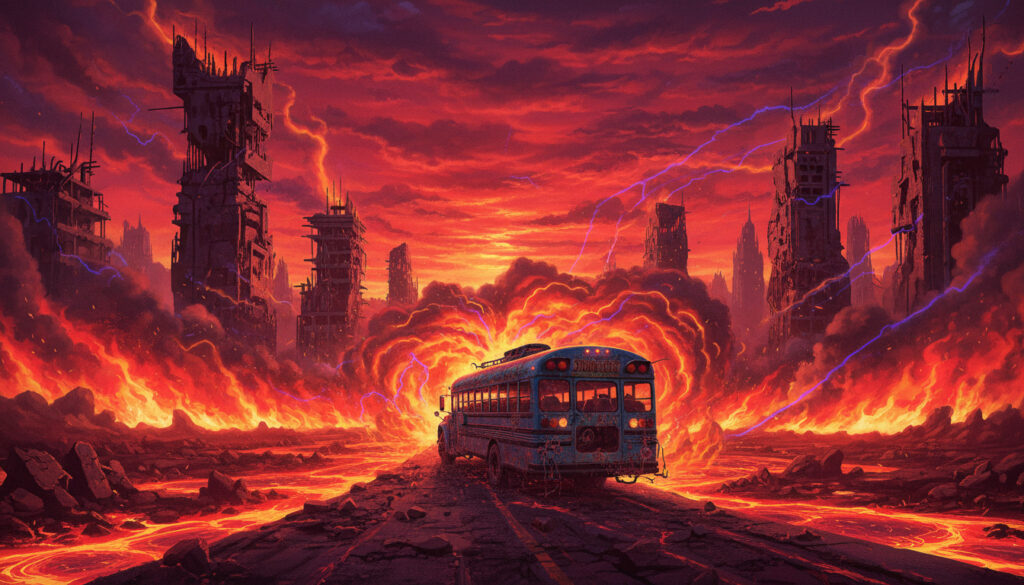
This Is the End – The Doors Lyrics Meaning and History
“The End” by The Doors opens with a whisper that became one of rock music’s most recognizable incantations: “This is the end, beautiful friend.” The eleven-minute opus closes the band’s self-titled debut album with a hypnotic fusion of psychedelic instrumentation and spoken-word poetry that transformed from a personal breakup lament into a sprawling meditation on death and psychological transformation.
Jim Morrison composed the lyrics during the emotional aftermath of his separation from Mary Werbelow, initially crafting a simple farewell that would evolve dramatically during the band’s 1966 residency at the Whisky a Go Go. The studio recording captures this live development, preserving the raw intensity that made the track a defining statement of 1960s rock experimentation.
Released on January 4, 1967, the song defies conventional pop structure. It builds from quiet, repetitive refrains into a chaotic explosion of apocalyptic imagery and controversial theatrical declarations, establishing a template for ambitious rock compositions that followed.
What Are the Lyrics to “This is the End” by The Doors?
The Doors
The Doors
January 4, 1967
11:41
The composition opens with the haunting refrain: “This is the end, beautiful friend / This is the end, my only friend, the end / Of our elaborate plans, the end / Of everything that stands, the end.” The lyrics feature unfinished sentences and pauses for suspense, building toward the dramatic spoken-word narrative that defines the track’s second half.
- Morrison wrote the lyrics as a breakup song for ex-girlfriend Mary Werbelow
- The track closes the band’s debut album
- Features explicit references to Sophocles’ Oedipus Rex
- Evolved from a short tune to a 12-minute epic during live performances
- Appears in Francis Ford Coppola’s 1979 film Apocalypse Now
- Contains the iconic opening line “This is the end, beautiful friend”
| Genre | Psychedelic rock |
|---|---|
| Writer | Jim Morrison |
| Producer | Paul A. Rothchild |
| Label | Elektra |
| Opening Lyric | “This is the end, beautiful friend” |
| Oedipal Reference | “Father? Yes son? I want to kill you…” |
| Notable Film Use | Apocalypse Now (1979) |
| First Live Performances | Whisky a Go Go, 1966 |
| Lyrics Available At | Genius |
What Is the Meaning of “The End” by The Doors?
Morrison described the composition initially as a “goodbye love song” that gradually transformed into an apocalyptic vision. The narrative arc draws from Old Testament end-times imagery, utilizing crescendo dynamics and scattered geographical references to create an atmosphere of inevitable conclusion. Story and Drama notes that the work blends attraction, regret, and existential dread into a cyclical meditation on beginnings and endings.
Death appears personified throughout as “my only friend,” representing a constant beyond pain. Morrison articulated this philosophy in interviews, stating that life hurts more than death, and that at the point of death, the pain ceases.
Is “The End” by The Doors About the Oedipus Complex?
The song’s most controversial section directly references Sophocles’ Oedipus Rex, which Morrison had explored during his time at Florida State University. The climactic spoken-word passage features a dialogue culminating in the lines: “Father? Yes son? I want to kill you / Mother? I want to…” followed by a screamed unintelligible phrase. Far Out Magazine reports that Morrison acknowledged the Freudian parallel in a Rolling Stone interview, describing the narrative as concerning “a man who inadvertently killed his father and married his mother.”
Keyboardist Ray Manzarek interpreted the Oedipal lines metaphorically, explaining that “kill the father, fuck the mother” symbolizes destroying socially instilled concepts to return to primal reality and authentic personal essence rather than representing literal violence.
When and How Was “The End” by The Doors Created?
Who Wrote “The End”?
Jim Morrison penned the original lyrics as a direct response to his separation from Mary Werbelow, channeling personal turmoil into poetic form that would expand far beyond its initial intimate scope.
What Album Is “The End” By The Doors On?
The track serves as the finale on the band’s self-titled debut album The Doors. Wikipedia documents that the studio version captures the song’s evolution from live performances, beginning with quiet drum rolls and guitar before building to chaotic sonic explosions.
The Whisky a Go Go Residency
During 1966 performances at the Whisky a Go Go, the composition grew from a simple breakup tune into a twelve-minute epic. Morrison developed the lyrics through improvisation, adding the Oedipal section and apocalyptic imagery over months of residency. The recording preserves the tearful emotional intensity of Morrison’s delivery during these sessions.
Why Is “The End” By The Doors Controversial?
The controversy stems primarily from the explicit Oedipal dialogue and its perceived obscenity. The ambiguity of the screamed final line—whether completing the Freudian triangle literally or remaining abstract—sparked immediate debate among producers and band members regarding artistic expression versus gratuitous shock.
Morrison’s emotional state during recording amplified these tensions. He reportedly broke down in tears while questioning whether audiences would understand the intended psychological symbolism, creating a moment of vulnerability that underscored the work’s contentious nature.
The song contains explicit references to patricide and maternal relations drawn from Greek tragedy, which prompted censorship discussions and venue restrictions during the 1960s.
The studio version preserves Morrison’s live vocal delivery, captured during sessions where he visibly emoted and questioned the accessibility of the Oedipal symbolism he had woven into the performance.
How Did “The End” Develop Through Live Performances?
- 1966 (Whisky a Go Go): The song originates as a short breakup tune for Mary Werbelow, gradually extending to twelve minutes through extended jams and Morrison’s improvised poetry.
- 1966 (Continued Development): The Oedipal section emerges during nightly performances, transforming the narrative from personal confession into mythological theater.
- January 4, 1967: The studio version is released on The Doors, capturing the live evolution in a definitive recording.
- 1979: Francis Ford Coppola features the composition in Apocalypse Now, cementing its association with apocalyptic atmosphere and modern warfare.
- Present: The track endures as a streaming staple and classic rock standard, with the studio recording preserved as the definitive version despite numerous live variations. Source: Official Recording
What Facts Are Verified About “The End” Versus What Remains Uncertain?
| Established Information | Information That Remains Unclear |
|---|---|
| Jim Morrison wrote lyrics following breakup with Mary Werbelow | The exact wording of the screamed final line in the Oedipal section |
| Song references Sophocles’ Oedipus Rex explicitly | Precise symbolic meaning of the “blue bus” imagery |
| Album version runs 11 minutes 41 seconds | Full extent of autobiographical subtext beyond Werbelow connection |
| Released January 4, 1967 on Elektra Records | Whether Morrison intended literal or purely psychological readings |
| Ray Manzarek confirmed symbolic interpretation of Oedipal lines | Specific improvisational changes made during each 1966 performance |
What Cultural Context Produced “The End”?
The composition emerged during the apex of 1960s psychedelia, when rock musicians experimented with extended forms and literary references previously uncommon in popular music. Morrison’s background in film and theater influenced the cinematic structure, which unfolds with distinct acts resembling Greek tragedy.
The work reflects the era’s fascination with altered consciousness, Jungian archetypes, and the exploration of death as a philosophical concept rather than merely an end. The Doors’ official archives note that Morrison viewed himself as a “huge fiery comet,” creating art intended to remain unforgettable through its blending of personal confession with mythological density.
Contemporary culture continues to grapple with the song’s implications, as evidenced by its inclusion in modern critical discussions and retrospective analyses of twentieth-century music.
What Did Jim Morrison Say About the Song’s Meaning?
“It’s about a man who inadvertently killed his father and married his mother.”
— Jim Morrison, in a Rolling Stone interview cited by Rolling Stone archives
“Life hurts a lot more than death. At the point of death, the pain is over.”
— Jim Morrison, on the personification of death in the lyrics
Why Does “The End” Remain a Defining Psychedelic Rock Composition?
The song endures as a landmark merging poetic narrative with musical experimentation, representing the moment when rock music embraced complex literary and psychological themes without commercial compromise. Its influence extends into cinema and cultural studies, while the recording preserves a specific moment of 1960s artistic ambition.
For those exploring cultural milestones across decades, from 1960s psychedelia to contemporary screen performances, consider reviewing James Norton Movies and TV Shows – Full Filmography and Best Roles.
Frequently Asked Questions
What movies feature “The End” by The Doors?
The song appears prominently in Francis Ford Coppola’s 1979 film Apocalypse Now, enhancing the movie’s Vietnam War psychedelia. For contemporary viewing recommendations, see Best TV Shows 2024 – Top Rated on Rotten Tomatoes.
What album is “The End” by The Doors on?
The track appears as the closing song on the band’s self-titled debut album The Doors, released January 4, 1967.
How long is the studio version of “The End”?
The album version runs for 11 minutes and 41 seconds, though live performances often extended beyond 12 minutes through improvisation.
Who was Mary Werbelow?
Mary Werbelow was Jim Morrison’s ex-girlfriend; he initially wrote “The End” as a breakup song following their separation before it evolved into its final mythological form.
What is the “blue bus” reference in the lyrics?
The “blue bus” appears as symbolic imagery representing journeys into the unknown, though its precise meaning remains subject to interpretation.
Did The Doors perform “The End” after 1967?
The band continued performing the song throughout their career, though the 1967 studio version remains the definitive recording.
More related posts
 78 kg in Stone: Complete Conversion and Health Assessment
 KFC Drive Thru Near Me: How It Works, Menu & the 7-Minute Rule
 Noah’s Ark: Fact, Fiction, and the Search for the Truth
 Antony Gormley: Biography, Famous Works, and Sculptures
 Hull City v Oxford United: Prediction, Stat & Head-to-Head
 Marco Pierre White: Michelin Stars, Restaurants & Net Worth
 Taylor Fritz: Tennis Career, Family, and Fatherhood
 10 Funniest Jokes for Adults: Hilarious One-Liners
