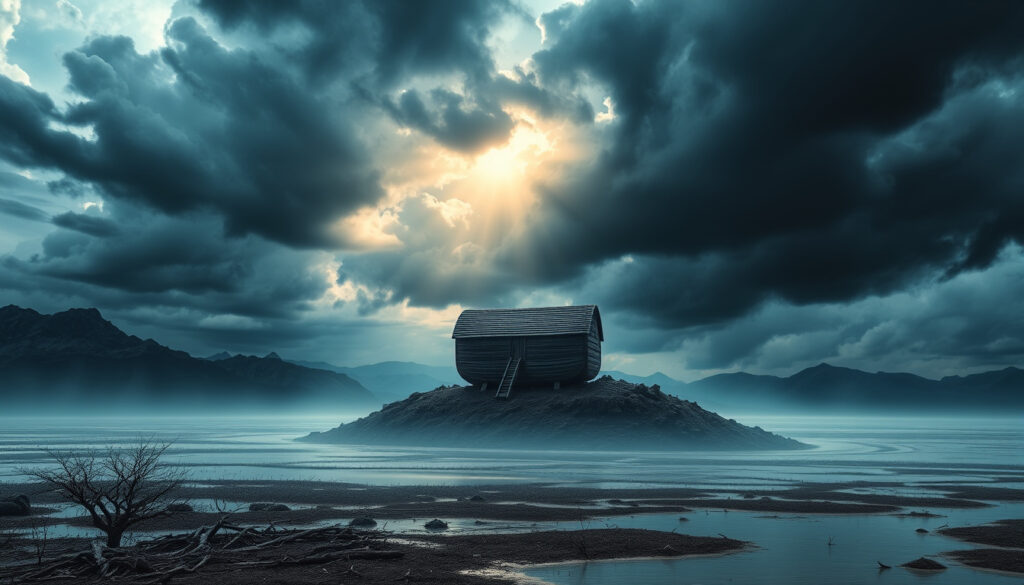
Noah’s Ark: Fact, Fiction, and the Search for the Truth
The story of Noah’s Ark is one of the most famous in the Bible, but it also sparks intense debate among archaeologists, geologists, and theologians. While the search for the Ark’s physical remains continues, the evidence remains deeply contested.
Ark dimensions (cubits): 300 x 50 x 30 · Number of humans saved: 8 · Duration of flood (days): 40 days and nights
Quick snapshot
- The biblical text describes the Ark and Flood (Wikipedia (encyclopedia))
- Mount Ararat is the traditional landing site (Wikipedia (encyclopedia))
- Real animal species exist (Fox News (news outlet))
- Physical location of the Ark (Christian Daily (Christian news site))
- Historical veracity of a global flood (CSU Northridge geology page (academic critique))
- Whether dinosaurs were contemporaries (Wikipedia (encyclopedia))
- Durupınar site photographed in 1959 (Fox News (news outlet))
- Recent 2024 soil tests show higher organic matter (Fox News (news outlet))
- No conclusive evidence established (Christian Daily (Christian news site))
- Further scientific study required (Christian Daily (Christian news site))
- Prophetic claims point to 2033 for discovery (Wikipedia (encyclopedia))
- Debate between faith and science continues (Christian Daily (Christian news site))
The table below outlines the biblical specifications for the Ark.
| Ark dimensions | 300 cubits long, 50 cubits wide, 30 cubits high (approx 450×75×45 ft) |
| Years to build | Unknown, but tradition suggests decades |
| Animals aboard | One pair of each unclean animal, seven pairs of clean |
| Passengers | Noah, his wife, three sons, and their wives – 8 people |
Is Noah’s ark a true story?
The Wikipedia entry for Noah’s Ark (encyclopedia) outlines the biblical account: God instructs Noah to build a massive wooden vessel to survive a global flood. The narrative appears in Genesis, and its historicity has been debated for centuries. Fox News (news outlet) notes that the Durupınar formation in Turkey is a modern candidate for the Ark’s remains, but that Turkish geographer Faruk Kaya (cited by Christian Daily) says the evidence remains inconclusive.
Do Catholics believe Noah’s Ark was real?
The Catholic Church does not require a literal interpretation of the flood narrative. The Wikipedia article on Noah’s Ark (encyclopedia) explains that many Catholics treat the account as allegorical, emphasizing the moral lesson of God’s judgment and mercy. The Catechism refers to the flood as a prefiguration of baptism, not a historical report.
For believers, the Ark’s truth isn’t tied to a specific site. For scientists, the lack of physical evidence makes a literal global flood untenable. The trade-off: you can hold the story as spiritually meaningful without demanding archaeological proof.
Why didn’t God put dinosaurs on Noah’s ark?
This question arises from a perceived conflict between the biblical timeline and the scientific understanding of dinosaur extinction. Wikipedia (encyclopedia) places dinosaur extinction at around 66 million years ago, long before humans appeared. Young-Earth creationists, however, believe dinosaurs and humans coexisted, a view promoted by Ark Encounter (creationist theme park).
Were dinosaurs really on Noah’s ark?
Creationist organizations argue that dinosaurs were on the Ark as “kinds” that later diversified. Fox News (news outlet) reports that the Ark’s dimensions (300×50×30 cubits) would have provided enough space for representative pairs of all land animals, including dinosaurs if they were alive then. Mainstream science rejects this, noting that the fossil record shows no evidence of human-dinosaur coexistence).
Young-Earth creationists face a difficult choice: either accept mainstream science and abandon a literal Ark, or maintain a young timeline and reject overwhelming geological evidence. No compromise satisfies both sides.
Has the real Noah’s ark been found?
Several expeditions have claimed to discover the Ark. The most prominent candidate is the Durupınar formation in eastern Turkey. Fox News (news outlet) reported in 2024 that soil tests found nearly three times more organic material inside the formation than outside, which the group Noah’s Ark Scans interprets as decayed wood. However, CSU Northridge (geology department) argues the formation is a natural rock structure, noting that microscopic studies show no traces of fossilized wood or carbon. Christian Daily (Christian news site) quotes geographer Faruk Kaya: “scientific and archaeological data would be required to identify the formation as the Ark.”
Where is Noah ark now?
Noah’s Ark is traditionally said to have landed on Mount Ararat in Turkey. Wikipedia (encyclopedia) notes that claims have been reported since antiquity, including a 1948 Associated Press story about Kurdish villagers discovering a petrified wooden ship. Wood samples from later expeditions were dated to around 1,200–1,700 years old, far too young to be the Ark.
Why is 2033 important?
Some evangelical groups have predicted the Ark will be discovered by the year 2033. This date is tied to prophetic timelines. Wikipedia (encyclopedia) mentions that such prophecies are not supported by mainstream archaeology.
Each new discovery claim generates headlines, but every scientifically rigorous investigation has either debunked or labeled the evidence preliminary. For the public, the search for Noah’s Ark is a test of faith versus empirical proof.
Who was the first person to go to heaven alive?
According to the Bible, two figures were taken to heaven without dying: Enoch and Elijah. Wikipedia (encyclopedia) says Enoch is described in Genesis as “walking with God” and then “was no more, because God took him.” Elijah’s ascension in a whirlwind is recorded in 2 Kings. Christian tradition views them as exceptions to the general rule of death.
Does God know you before you are born?
The Bible contains passages that suggest divine foreknowledge. Wikipedia (encyclopedia) notes that Jeremiah 1:5 says, “Before I formed you in the womb I knew you.” This verse is used by many Christians to argue that God has a plan for every person. Theologically, the concept connects to predestination, but interpretations vary widely.
What is the biggest sin that God will never forgive?
The “unforgivable sin” is mentioned in the Gospels: blasphemy against the Holy Spirit. Wikipedia (encyclopedia) explains this as a persistent rejection of God’s grace, not a single act. Many denominations teach that any sin can be forgiven if one repents, making the “biggest sin” one that is unrepented.
Timeline of Noah’s Ark searches
Six key moments in the quest for the Ark, one pattern: initial excitement followed by scientific skepticism.
- c. 2500 BCE (traditional): Bishop Ussher dates the Flood to this period (Wikipedia (encyclopedia)).
- 1840: First documented modern search on Mount Ararat (Wikipedia (encyclopedia)).
- 1959: Durupınar formation photographed by a Turkish pilot (Fox News (news outlet)).
- 2006: Expedition by Noah’s Ark Ministries International (Wikipedia (encyclopedia)).
- 2024: Soil tests at Durupinar show organic anomalies (Fox News (news outlet)).
- 2033 (prophetic): Some evangelicals claim the Ark will be found by this year (Wikipedia (encyclopedia)).
Confirmed facts vs. What’s unclear
Confirmed facts
- The biblical text describes the Ark and Flood (Wikipedia (encyclopedia))
- Mount Ararat is the traditional landing site (Wikipedia (encyclopedia))
- Real animal species exist (Fox News (news outlet))
What’s unclear
- Physical location of the Ark (Christian Daily (Christian news site))
- Historical veracity of a global flood (CSU Northridge geology page (academic critique))
- Whether dinosaurs were contemporaries (Wikipedia (encyclopedia))
Key voices on Noah’s Ark
The ark is a symbol of the Church in which protection and safety can be found if you know to get aboard.
– Reddit user (community discussion)
Noah’s ark was a massive ship, built at God’s command, that saved Noah, his family, and representatives of every kind of land-dependent, air-breathing animal.
Noah’s Ark is a significant narrative found in the biblical book of Genesis, where the patriarch Noah builds a large wooden vessel to survive a divinely sent flood.
The search for Noah’s Ark embodies a fundamental tension between faith and evidence. While geological analysis of the Durupınar formation points to a natural origin, the story continues to inspire hope and curiosity. For believers, the lesson is that the Ark’s meaning transcends its physical existence. For skeptics, the lack of verifiable proof is definitive. For everyone else, the mystery remains—and that may be the most human part of all.
If you enjoyed this exploration, you might also like our piece on How Old Is Earth – Science, Religion and Cosmic Timeline and Ned Flanders: Catchphrase, Religion & Character Analysis.
noahsarkscans.com, en.wikipedia.org, youtube.com, youtube.com
Frequently asked questions
How long did Noah live?
According to Genesis, Noah lived 950 years.
How many animals were on the Ark?
The Bible says one pair of each unclean animal and seven pairs of clean animals. The exact number is not specified.
What did the Ark look like?
The Ark is described as a large wooden box-like vessel, 300 cubits long, 50 cubits wide, and 30 cubits high, with three decks and a roof.
Was the flood global or local?
Interpretations vary. A literal reading implies a worldwide flood; many scholars and denominations argue for a local flood in the ancient Near East.
Is there any evidence of a great flood?
Geologists point to the lack of evidence for a global flood. Some local flood stories exist in other cultures, but no universal inundation has been confirmed.
Does the Quran mention Noah’s Ark?
Yes, the Quran mentions Noah (Nuh) and the flood, with a similar but not identical narrative. The Ark is said to have landed on Mount Judi, not Ararat.
How did Noah’s family repopulate the earth?
The biblical genealogy traces all post-flood humanity to Noah’s three sons: Shem, Ham, and Japheth, and their wives.
More related posts
 Bournemouth vs Aston Villa – Preview Prediction Team News
 Mark Williams Snooker: Net Worth, Family & Ranking
 90 Euros in Pounds – Current Rate and Conversion Guide
 Compare the Market Travel Insurance: Quotes from £1.03
 Ex Display Summer Houses for Sale: Cost & Planning Guide
 Ca t of Man v Baby: Full Li t of Actor and Character (2025)
 Maddox Jolie-Pitt – Biography Family Education Career
 Scotland School Holidays 2025: Term Dates by Council
