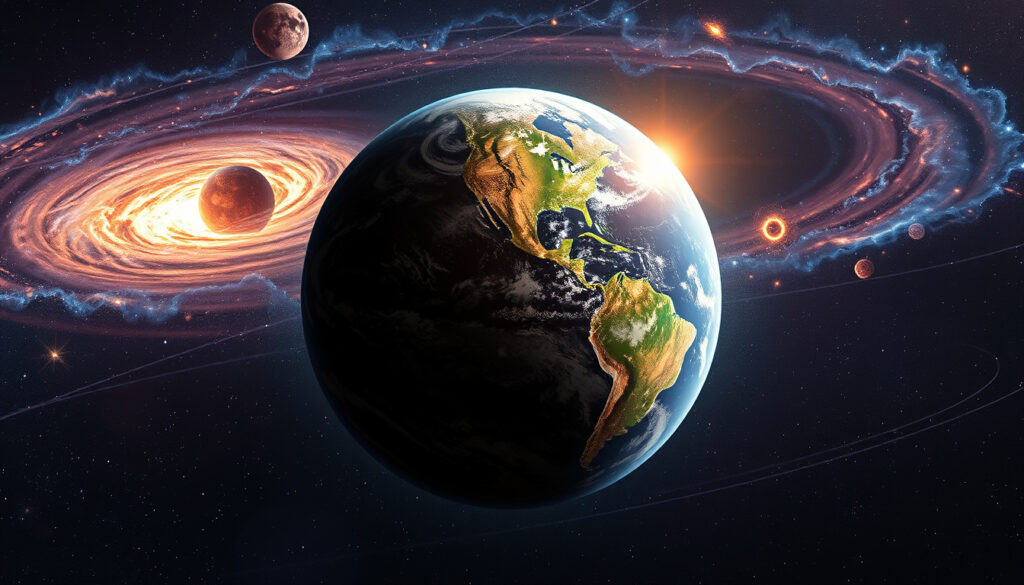
Scientists have established that Earth formed approximately 4.54 billion years ago, making our planet nearly three times older than all complex life that has ever existed on its surface. This age determination rests on one of the most robust convergence of evidence in modern science, drawing from multiple independent dating methods applied to rocks, meteorites, and lunar samples. Understanding Earth’s age requires examining both the scientific methods used to calculate it and the various perspectives different traditions bring to this question.
The question of Earth’s age has occupied human curiosity for millennia, prompting inquiries that span scientific disciplines from geology to astrophysics. While the scientific community has reached substantial consensus on the approximate age, cultural and religious traditions offer diverse interpretations that reflect broader worldviews about creation and cosmic origins. Exploring these perspectives alongside scientific evidence provides a fuller picture of humanity’s relationship with deep time.
This examination draws on peer-reviewed research, institutional sources, and documented scholarly perspectives to present factual information while acknowledging where uncertainty exists or where different frameworks yield different conclusions.
How Old is the Earth According to Science?
The scientific consensus places Earth’s age at approximately 4.54 billion years, with a margin of error of plus or minus 0.05 billion years. This figure represents one of the most thoroughly validated findings in modern science, supported by multiple independent lines of evidence that converge on remarkably consistent results. The methods used to determine this age primarily involve radiometric dating techniques that measure the decay of radioactive isotopes in geological materials.
Radiometric Dating and Its Role in Age Determination
Radiometric dating measures the decay of radioactive isotopes within rocks and meteorites, relying on the assumption that radioactive decay rates have remained constant over geological time. The most widely used isotope pair for dating Earth materials is uranium-238 decaying to lead-206, which has a half-life of approximately 4.47 billion years. Other important isotope systems include potassium-40 to argon-40 (half-life 1.25 billion years) and rubidium-87 to strontium-87 (half-life 48.8 billion years). Wikipedia documents the extensive evidence supporting this approach.
The most reliable age determinations come from calcium-aluminium-rich inclusions in meteorites, dated to 4.567 billion years and representing the Solar System’s lower age limit. Lead-lead dating of the Canyon Diablo meteorite yielded 4.55 ± 0.07 billion years in 1956, a figure that aligns closely with modern cosmochemical estimates.
On Earth itself, the oldest known materials are zircon crystals from the Jack Hills in Western Australia, dated to approximately 4.404 billion years. These tiny crystals provide direct evidence that Earth’s crust had solidified and cooled relatively quickly after planetary formation. The USGS provides detailed documentation of these age determinations.
Key Radioactive Decay Systems Used in Dating
| Isotope Pair | Half-Life | Primary Application |
|---|---|---|
| Uranium-238 → Lead-206 | 4.47 billion years | Meteorites, Earth age estimation |
| Potassium-40 → Argon-40 | 1.25 billion years | Volcanic rocks and minerals |
| Rubidium-87 → Strontium-87 | 48.8 billion years | Isochron dating methods |
| Uranium-235 → Lead-207 | 704 million years | Cross-checking uranium-lead dates |
Earth’s Formation and Differentiation
Earth formed through a process called accretion, where smaller bodies in the protoplanetary disk collided and merged over tens of millions of years. The Sun formed slightly earlier in this disk, and planetary formation followed as material coalesced under gravitational forces. Differentiation occurred as Earth grew, with heavier elements like iron and nickel sinking toward the center while lighter materials rose to form the crust and mantle. The American Chemical Society’s overview of dating methods explains this formation process.
How Old is the Earth According to Islam and Hinduism?
Religious traditions approach the question of Earth’s age from frameworks that differ substantially from scientific methodology. These perspectives often emphasize theological meaning, spiritual narrative, and questions of purpose rather than empirical age determination. Understanding these viewpoints requires careful attention to how different communities interpret their sacred texts and traditions.
Islamic Views on Creation
Islamic cosmology presents creation as occurring through divine command, with Allah bringing the heavens and earth into existence. The Quran describes creation in terms that some interpreters have understood as suggesting a specific timeframe, though scholarly interpretations vary considerably. Many Muslim scholars and scientists have worked to reconcile Quranic descriptions with scientific findings, noting that the text’s primary purpose concerns spiritual guidance rather than scientific detail. The concept of divine creation emphasizes Allah’s ongoing sustenance of the universe rather than specifying exact ages for geological formations.
Within Islamic scholarship, perspectives on creation range from those who read Quranic passages as literal historical accounts to those who understand them as metaphorical expressions of divine power. This interpretive diversity mirrors similar variations found across religious traditions worldwide.
Hindu Perspectives and Cosmic Time
Hindu traditions offer some of the most expansive conceptions of cosmic time found in any religious system. The concept of yugas describes vast cycles of creation and dissolution, with individual yugas spanning millions of years and complete cycles extending into billions. These timescales have drawn comparisons to scientific estimates of deep time, though the relationship between mythological cycles and geological ages remains a matter of interpretive discussion. The cyclical nature of Hindu cosmology fundamentally differs from the linear chronology typically assumed in Western scientific frameworks.
Young Earth Perspectives
Some religious communities, predominantly within certain Protestant traditions, maintain that Earth is approximately 6,000 to 10,000 years old based on literal interpretations of scriptural genealogies. Organizations such as Answers in Genesis argue that radiometric dating methods produce inflated ages due to unproven assumptions about constant decay rates and initial daughter isotope concentrations. They cite examples such as 1986 Mount St. Helens lava, which radiometric dating assessed at 0.27 to 3.5 million years despite being known to be less than 70 years old. These critiques represent a substantial body of work dedicated to challenging mainstream scientific consensus.
“Radiometric dating assumes that radioactive decay has always occurred at constant rates, but this assumption cannot be verified without knowing the true ages of rocks in advance.”
— Biblical Science Institute analysis on radiometric dating limitations
How Old is the Earth Compared to the Universe and Sun?
Contextualizing Earth’s age within the broader cosmic timeline reveals how our planet fits into the larger story of universal evolution. The universe itself is estimated to be approximately 13.8 billion years old, based on observations of cosmic expansion and the cosmic microwave background radiation. This means Earth, at 4.54 billion years, represents less than one-third of the age of the cosmos, yet it formed relatively early in our galaxy’s development. NASA’s documentation of Big Bang theory provides the foundational framework for understanding cosmic age.
Comparison with the Sun
The Sun formed approximately 4.6 billion years ago, making it nearly the same age as Earth. Both bodies emerged from the same protoplanetary disk, with the Sun capturing the vast majority of mass in our solar system while planetary embryos coalesced from remaining material. The nearly identical ages reflect their common origin, though the Sun’s composition and structure have changed dramatically over this period while Earth has undergone even more dramatic transformations through geological and biological processes. For more on statistical concepts like median calculations, understanding formation timelines provides important context.
The universe preceded Earth by approximately 9.3 billion years. Within our solar system, the Sun formed slightly before Earth, with both bodies sharing a common origin in the same nebular cloud approximately 4.6 billion years ago.
The Broader Cosmic Timeline
Placing Earth within the 13.8-billion-year history of the universe reveals the extraordinary timescales involved. The first generation of stars formed approximately 200 to 300 million years after the Big Bang, producing heavier elements through nuclear fusion. Our solar system represents a relatively recent development in cosmic history, formed from material recycled through multiple generations of stars. The atoms composing Earth were forged in earlier stellar explosions, meaning we literally carry matter forged in the hearts of ancient stars.
Key Events in Earth’s Early History
Earth’s history encompasses dramatic transformations from its initial formation through the emergence of life and the development of conditions suitable for complex organisms. The timeline below represents major milestones based on geological evidence, though precise dates remain subject to ongoing refinement as new discoveries emerge.
Formation and Early Differentiation
Following initial accretion around 4.54 to 4.6 billion years ago, Earth underwent rapid differentiation as heat from collisions and radioactive decay melted the planet. Iron and nickel sank to form the core while lighter materials rose to create the crust and mantle. This period of heavy bombardment, when remaining debris continuously struck the growing planet, gradually diminished over approximately 500 million years.
- 4.54 billion years ago — Earth completes accretion from planetesimals; planetary differentiation begins
- 4.4 billion years ago — Formation of earliest known zircon crystals indicating solid crust
- 4.0 to 3.5 billion years ago — Earliest evidence of life emergence
- 2.5 billion years ago — Great Oxidation Event transforms atmospheric composition
- 541 million years ago — Cambrian explosion marks rapid diversification of complex life
The Emergence of Life
The earliest confirmed evidence of life dates to approximately 3.5 to 4 billion years ago, based on isotopic signatures in ancient rocks and fossilized microorganisms. These earliest life forms were simple single-celled organisms that gradually transformed Earth’s atmosphere through metabolic processes. The emergence of photosynthesis eventually led to oxygen accumulation, fundamentally changing planetary conditions and enabling the evolution of complex life requiring aerobic respiration. The University of California Museum of Paleontology documents these evolutionary milestones.
The research materials examined do not provide detailed documentation for events occurring specifically 2 billion years ago beyond noting the Great Oxidation Event. Specific claims about Earth formation or life at exactly 2 billion years would require additional verification from primary sources.
What We Know with Confidence and What Remains Uncertain
Scientific understanding of Earth’s age exemplifies both remarkable confidence in certain conclusions and honest acknowledgment of remaining uncertainties. Distinguishing between these categories helps clarify the nature of scientific knowledge and its relationship to ongoing research questions.
Established Information
- Earth formed approximately 4.54 billion years ago
- Multiple independent dating methods yield consistent results
- The Sun formed slightly before Earth at approximately 4.6 billion years
- The universe is approximately 13.8 billion years old
- Radiometric dating relies on well-understood decay physics
- Oldest known Earth materials date to approximately 4.4 billion years
- Life emerged at least 3.5 billion years ago
Information That Remains Less Certain
- Precise conditions during Earth’s earliest formation
- Exact mechanisms of life origin
- Details of late heavy bombardment timing and intensity
- Whether accelerated decay occurred in the past
- Interpretation of religious texts regarding creation timing
- Specific processes during planetary differentiation
- Whether all isotope systems behaved consistently over deep time
The scientific method’s strength lies in its self-correcting nature. When different methods yield consistent results, confidence increases. When methods produce conflicting results, scientists investigate the sources of disagreement. The convergence of radiometric dating, astronomical observations, and geological evidence around a 4.54-billion-year estimate represents exactly this kind of robust, cross-validated conclusion.
Understanding Radiometric Dating in Context
Radiometric dating has revolutionized understanding of deep time, yet its methodology deserves careful explanation. The technique assumes that radioactive decay rates have remained constant throughout Earth’s history and that systems remained closed after initial formation. Scientists address these assumptions through multiple lines of verification, including cross-checking with different isotope systems and comparing results from different materials.
Mainstream scientific institutions, including the USGS and American Chemical Society, maintain that radiometric dating methods are reliable when applied correctly and that the convergence of multiple independent methods provides strong evidence for their validity. The Biblical Science Institute presents alternative interpretations, arguing that certain assumptions underlying radiometric dating cannot be independently verified.
“The consistency of radiometric dating results with geological field observations, stratigraphic principles, and astronomical models provides multiple independent lines of evidence supporting the reliability of age estimates.”
— USGS Open-File Report on geochronology methods
Summary: What We Can Conclude
Earth’s age of approximately 4.54 billion years represents one of science’s most thoroughly validated findings, supported by convergent evidence from multiple independent methods. This age situates Earth as younger than the universe but nearly as old as the Sun, with both sharing common origin in the same protoplanetary region. Religious traditions offer diverse perspectives on creation, ranging from interpretations consistent with scientific dating to views maintaining much younger ages based on scriptural interpretation. Understanding Earth’s age requires engaging with both empirical evidence and the philosophical frameworks through which different communities interpret that evidence. For those interested in statistical concepts like median calculations, the precise age determination demonstrates how scientific consensus emerges through rigorous methodology and independent verification.
Frequently Asked Questions
How old is Earth according to the most recent scientific estimates?
Current scientific consensus estimates Earth at 4.54 ± 0.05 billion years, determined primarily through radiometric dating of meteorites, lunar samples, and Earth’s oldest rocks.
How does Earth’s age compare to the universe’s age?
Earth at 4.54 billion years is substantially younger than the universe, which is approximately 13.8 billion years old. Earth formed roughly one-third of the way through cosmic history.
What is the difference between Earth’s age and the Sun’s age?
The Sun formed approximately 4.6 billion years ago, making it nearly the same age as Earth. Both bodies emerged from the same protoplanetary disk around the same time.
How do Islamic perspectives view Earth’s age?
Islamic cosmology emphasizes divine creation by Allah, with interpretation varying among scholars. Some reconcile Quranic descriptions with scientific estimates of deep time, while others maintain different interpretive frameworks.
What does Hinduism say about Earth’s age?
Hindu traditions describe vast cosmic cycles called yugas spanning millions to billions of years. These cyclical timescales differ fundamentally from linear scientific chronology, with interpretive discussions ongoing regarding their relationship to geological time.
Why do some people believe Earth is much younger than scientific estimates?
Some religious communities interpret scriptural genealogies and creation narratives literally, leading to estimates of approximately 6,000 to 10,000 years. They argue that radiometric dating assumptions cannot be independently verified and point to apparent inconsistencies in dating results.
What is the oldest evidence of life on Earth?
The earliest confirmed evidence of life dates to approximately 3.5 to 4 billion years ago, based on isotopic signatures and fossilized microorganisms found in ancient geological formations.
How reliable is radiometric dating?
Radiometric dating is considered highly reliable by mainstream scientific institutions, with multiple independent methods yielding consistent results. Scientists verify findings through cross-checking different isotope systems and comparing with geological and astronomical evidence.