What Is a Corn on Your Foot? Causes & Safe Removal
If you’ve ever felt a sharp, burning sensation under your toe while walking, you’ve probably dealt with a corn. These small, cone-shaped thickenings of skin form when your foot tries to protect itself against repeated friction or pressure—and that protective response can become surprisingly painful. Corns are closely related to calluses, but knowing which one you’re dealing with makes a real difference in how you treat it. This guide walks through the causes, safe removal methods, and when to hand things off to a podiatrist, backed by guidance from Mayo Clinic, the NHS, and Cleveland Clinic.
Primary Cause: Friction or pressure on skin · Common Locations: Feet, hands, toes · Skin Response: Thickened, hardened layers · Typical Trigger: Ill-fitting shoes · Pain Level: Often painful when pressed
Quick snapshot
- Corns are smaller than calluses, with a hard central core that presses deep into skin (Advanced Foot Care)
- They typically form on the tops and sides of toes where shoes create focused pressure (Virginia Foot and Ankle)
- A corn is technically a type of callus, differing mainly in location and pain level (Mountain View Foot and Ankle)
- Exact timeframes for drawing agents to fully resolve a corn vary case by case
- Studies do not yet clarify which OTC products outperform others in controlled settings
- Salicylic acid at 40% softens the hardened core over repeated applications (Mayo Clinic)
- Soaking 5–10 minutes in warm water followed by gentle filing accelerates the process (Cleveland Clinic)
- If pressure continues, corns recur regardless of treatment—addressing shoe fit is essential (Austin Foot and Ankle)
- High-risk patients (those with diabetes or poor circulation) should see a podiatrist rather than self-treat (Cleveland Clinic)
Corns and calluses share a common origin—repeated friction—but they differ in telling ways. Three patterns emerge across cases: corns concentrate where shoes pinch, calluses spread where friction is diffuse, and professional treatment consistently outperforms cutting corners at home.
| Label | Value |
|---|---|
| Formation Trigger | Skin rubs against shoe or bone |
| Pain Trigger | Direct pressure on core |
| Self-Resolution | Possible with friction relief |
| Home Tools | Pumice stone, pads |
| Salicylic Acid Strength | 40% patches (Rx or OTC) |
| Soak Duration | 5–10 minutes in warm water |
| Core Characteristic | Hard central plug pressing deep |
| Common Location | Tops and sides of toes |
| Podiatrist Tool | Surgical blade for debridement |
| Contraindication | Diabetes, poor circulation, neuropathy |
The pattern is clear: corns respond to softening agents and pressure relief, but structural foot problems keep them coming back without professional intervention.
How do you get rid of a corn on your foot?
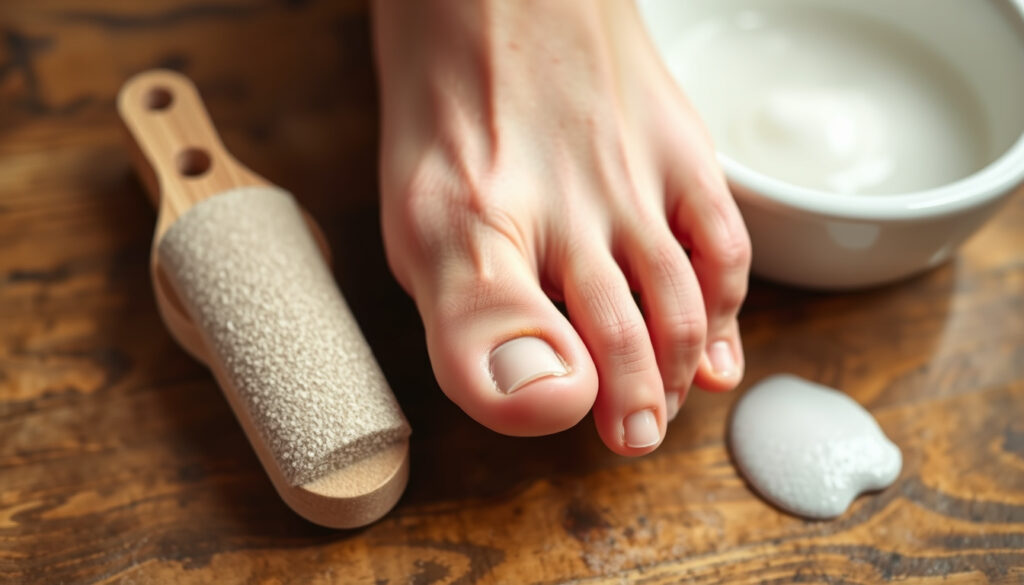
Safe removal starts with softening the skin before you touch it. The Cleveland Clinic recommends soaking the affected foot in warm water for 5–10 minutes to loosen the hardened layers, then gently filing with a pumice stone or emery board in one consistent direction—never back and forth, which can tear healthy skin.
Safe home removal methods
- Soak feet in warm water for 5–10 minutes daily, then file the softened surface with a pumice stone
- Apply moisturizers containing salicylic acid, urea, or ammonium lactate to soften skin before filing (Medical News Today)
- Use over-the-counter corn pads for cushioning, but avoid medicated pads without podiatrist advice since they can irritate surrounding skin (Advanced Foot Care)
- Place foam or silicone wedges between toes to reduce pressure on soft corns that develop between digits (Medical News Today)
When to see a podiatrist
The Cleveland Clinic advises against self-treatment if you have diabetes, poor circulation, nerve damage, or fragile skin—these conditions raise the stakes for even minor foot injuries. A podiatrist can remove corns with a surgical blade in a single office visit, painless on dead tissue, while leaving the protective skin layer intact (American Podiatric Medical Association). Custom orthotics or padded inserts address the underlying pressure, preventing recurrence where shoes or foot structure are the root cause (Mayo Clinic).
Soaking and filing at home works for uncomplicated corns in healthy feet. If you feel sharp pain when you press the center of the spot, or if the skin around it turns red or drains, stop home treatment and book a podiatrist appointment.
Do corns go away by themselves?
Corns often improve when you remove the source of pressure—switching to wider-toe-box shoes, using cushioning pads, or simply spending more time barefoot. But the Cleveland Clinic notes that untreated corns can cause infections, walking difficulty, and may eventually require antibiotics or surgery if left alone.
Factors influencing resolution
The depth of the core and how long the corn has been there affect how quickly it shrinks. A corn with a deep, hard central core (the defining feature that separates it from a callus) takes longer to soften than surface-level thickening. Structural foot issues like hammertoes or bunions keep pushing the skin, making self-resolution unlikely without addressing the underlying biomechanics.
Prevention to speed healing
- Wear properly fitted shoes with adequate room in the toe box
- Use protective pads or orthotic inserts to redistribute pressure away from the corn site
- Avoid high heels or narrow shoes that squeeze toes together
- Keep feet moisturized to prevent skin from hardening further
What happens if you pick a corn on your foot?
Picking at a corn with fingernail clippers, scissors, or a razor blade is the single most dangerous thing you can do. The Cleveland Clinic states it plainly: never try to cut out, shave away, or remove corns or calluses with a sharp object. Cutting through live skin causes bleeding, opens a gateway for bacteria, and can trigger an infection that spreads deeper into soft tissue or bone.
Risks of self-removal
- Bleeding and open wound creation
- Bacterial infection entering through broken skin
- Worsening pain as the core is still embedded and the protective layer is gone
- Scarring that makes future treatment harder
Infection signs
Watch for increasing redness around the corn, warmth radiating outward, pus or fluid drainage, worsening pain, or red streaks tracking up the foot. Kaiser Permanente notes that infected corns may require oral antibiotics, and in rare cases where bone infection develops, surgery becomes necessary. Anyone with diabetes should treat any sign of foot infection as a medical emergency.
Diabetes amplifies every foot-injury risk. High blood sugar feeds bacterial growth, and poor circulation starves tissues of the immune cells they need to fight infection. A minor corn that a healthy person could treat at home can escalate to a serious ulcer—or worse—in someone with diabetes (Seattle Feet).
Is it okay to dig a corn out?
Digging out a corn at home is not recommended. Podiatrists use sterile surgical blades to excise the hardened core while leaving enough protective skin intact—something no household tool can replicate safely. Westbury Foot Care warns that self-treatment with strong acids or improvised tools risks damaging surrounding healthy tissue, and a professional can spot underlying mechanical issues (like a bone spur) that keep the corn coming back.
Why digging is dangerous
- No sterile field—bacteria from skin or tools enter the wound
- Removing too much skin leaves a painful open sore
- You cannot see or reach the deep central core without cutting deep into live tissue
- Sharp tools slip on hard skin, often cutting sideways into healthy areas
Professional alternatives
Podiatrists have access to 40% salicylic acid patches applied in-office, stronger than anything sold over the counter, plus surgical debridement that removes the core without damage to surrounding tissue. The American Podiatric Medical Association notes that larger corns are most effectively reduced with a surgical blade in an outpatient setting. For recurrent corns caused by structural deformities, cortisone injections can reduce pain, and in some cases surgery to correct hammertoe or bunion eliminates the pressure point entirely (Cleveland Clinic).
What draws a corn out?
Two agents reliably soften corn tissue enough for the body to resorb it: salicylic acid and consistent warm-water soaking. Mayo Clinic recommends 40% salicylic acid patches, available by prescription or in concentrated OTC formulations, applied after soaking when skin is softest.
Effective drawing agents
- Salicylic acid (40%): Keratolytic action dissolves the protein bonds holding the hardened skin together (Mayo Clinic)
- Warm water soaks (5–10 minutes): Softens the surface layer so filing can reduce thickness safely
- Urea or ammonium lactate creams: Hydrate and loosen thick skin when used daily before filing (Medical News Today)
- Cold pack (10–20 minutes): Reduces acute pain and swelling when the corn is actively inflamed (Cleveland Clinic)
Application timeline
Most people see noticeable softening within 3–5 days of consistent soaking and filing. Full resolution depends on how long the corn has been present and whether the underlying pressure continues. Corns that form over bone prominences or under hammertoes may take weeks to fully flatten, and they tend to return if shoe pressure resumes.
Stronger is not always better. Over-the-counter products with high concentrations of salicylic acid can burn surrounding healthy skin if applied carelessly. Apply petroleum jelly around the corn perimeter as a barrier before placing the acid patch, and never use these products on open skin or if you suspect infection.
How to safely remove a corn at home
- Soak. Fill a basin with warm water and soak the affected foot for 5–10 minutes to soften the hardened skin.
- File gently. While skin is still damp, use a clean pumice stone or emery board and rub in one direction only—never back and forth.
- Moisturize. Apply a cream containing salicylic acid, urea, or ammonium lactate to keep the skin pliable and accelerate softening.
- Protect. Place a non-medicated corn pad or moleskin ring around (not over) the corn to cushion pressure while walking.
- Monitor. If the corn does not soften within a week, or if pain worsens, stop and schedule a podiatrist visit.
Confirmed
- Corns form from friction per Cleveland Clinic
- NHS recommends padding over cutting per NHS
- Salicylic acid at 40% softens corns per Mayo Clinic
- Diabetics should never self-treat per Cleveland Clinic
Unclear
- Exact timeframes for OTC drawing agents vary by case
- Comparative effectiveness studies between OTC brands are limited
Quotes
Never try to cut out, shave away or remove corns or calluses with a sharp object.
— Cleveland Clinic (health system)
Treatment for corns and calluses is the same. It involves avoiding the repetitive actions that caused them to form.
— Mayo Clinic (academic medical center)
Calluses are larger, painless areas of thick skin that develop in response to friction, while corns are smaller, painful spots that form due to focused pressure.
— Advanced Foot Care (podiatry clinic)
Summary
Corns are a common foot complaint driven almost entirely by shoe pressure, and most cases resolve with a straightforward routine: soak, file, moisturize, and switch to better-fitting footwear. The risk comes when people try to cut or dig them out at home—something every major medical source explicitly warns against. For healthy feet, safe home care works. For people with diabetes, circulation problems, or persistent corns caused by foot deformities, the smart move is to see a podiatrist before a minor spot becomes a major infection.
Related reading: UTI causes and treatment
Painful foot corns from friction often respond to pumice and salicylic acid, as explored further in causes symptoms and treatment guide alongside common symptoms and prevention tips.
Frequently asked questions
What causes a corn on the bottom of the foot?
Bottom-of-foot corns usually develop from pressure between a bone (like a metatarsal head) and the ground, often from wearing thin-soled shoes, walking barefoot on hard surfaces, or having a foot structure that concentrates weight on one spot. They are technically calluses in location but behave like corns when a hard core forms.
What is the difference between a corn and a callus?
Corns are smaller, painful areas with a hard central core that presses deep into skin, typically found on the tops and sides of toes. Calluses are larger, usually painless areas of thickened skin from diffuse friction, most often on the soles and heels. Both are skin’s protective response to pressure, but the corn’s concentrated core makes it far more painful.
How can you prevent corns on your feet?
Wear shoes with a roomy toe box, avoid high heels that force toes forward into tight fronts, use cushioning pads or orthotic inserts to redistribute pressure, and keep feet moisturized so skin stays supple rather than hardening in response to friction.
When should you see a doctor for a foot corn?
Book a podiatrist appointment if you have diabetes, poor circulation, or neuropathy (see a doctor rather than self-treat), if the corn shows signs of infection (redness, warmth, pus, red streaks), if home treatment has not improved it within two weeks, or if you have a structural foot deformity like hammertoe or bunion causing recurrent corns.
Are there different types of foot corns?
Yes. Hard corns form on the tops and sides of toes where bone presses against shoe leather. Soft corns develop between toes where skin is compressed between bones. Seed corns are tiny clusters of hardened skin on the soles, often from pressure on specific weight-bearing points.
What shoes cause corns on the side of the foot?
Narrow-toed shoes, high heels that push body weight onto the front of the foot, and any footwear with stitching or seams pressing against the side of a toe are the main culprits. Shoes that are too tight across the ball of the foot also compress toes laterally, creating pressure points that develop into corns.
Can over-the-counter creams remove corns?
OTC creams containing salicylic acid, urea, or ammonium lactate can soften corns over time, especially when combined with regular soaking and gentle filing. They work best on surface layers and work more slowly than the 40% salicylic acid patches a podiatrist can apply. They are not a substitute for professional treatment if the corn has a deep central core or the person is high-risk.
More related posts
 Is Cornflour Gluten Free? A Coeliac Guide (Tesco, Aldi, Lidl)
 Sunderland A.F.C. Players: Squad, Salaries & Ratings 2025/26
 Amy Dowden Thomas Skinner Strictly – Partnership Controversy
 Longest Flight in the World – Singapore to New York Route
 18 Stone in Lbs – Convert 252 Pounds and Check Your BMI
 Marine Hotel North Berwick – Reviews, Amenities and Booking Guide
 Sutton in Ashfield Weather – Hourly Forecast and Week Ahead
 Are Strawberries Good for You? Benefits, Sugar, and More
