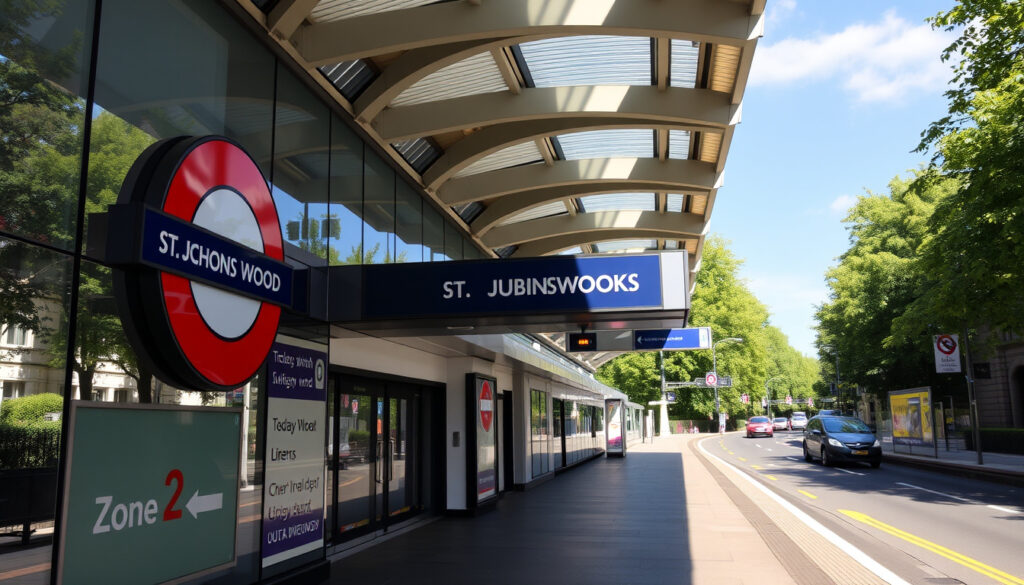
St Johns Wood Station: Jubilee Line Guide, Zone 2 Tube Info
St John’s Wood station sits on the Jubilee line just minutes from two of London’s most iconic landmarks—Abbey’s recording studio and the home of cricket. This Zone 2 stop makes an ideal base for music pilgrims and cricket fans alike.
Tube Line: Jubilee · Zone: 2 · Operator: Transport for London · Facilities: Escalators, Cash Machines, WiFi · Location: St. John’s Wood, City of Westminster
Quick snapshot
- Exact day of St John’s Wood station’s opening (only year 1939 confirmed)
- Current real-time service disruptions or recent station upgrades post-2022
- Precise daily passenger numbers during major events at Lord’s
- Last train to Stratford departs 23:52 daily (Transport for London)
- Trains run every 2-5 minutes between 05:54 and 00:18 (Wikipedia)
Three numbers tell you what you need to know about St John’s Wood station: Zone 2, Jubilee line, one change from central London.
| Label | Value |
|---|---|
| Zone | 2 |
| Line | Jubilee |
| Address | St. John’s Wood, London |
| Facilities | Escalators, Ticket Halls, Payphones |
| Accessibility | Check TfL website for step-free access details |
What tube line is St. Johns Wood on?
St John’s Wood sits on the Jubilee line, one of London’s busiest Underground arteries. The station occupies a spot between Swiss Cottage to the north and Baker Street to the south, making it a straightforward interchange for anyone travelling from central London or the western suburbs (Wikipedia). The line stretches 36.2 kilometres across 27 stations, running from Stratford in east London all the way to Stanmore in the north-west (London Transport Museum).
Jubilee line details
- Official opening: 30 April 1979, ceremonially launched by the Prince of Wales (Londonist)
- Originally proposed in 1965 under the name “Fleet line” (Londonist)
- 1996 stock carriages introduced in 1997, modernising the fleet (Londonist)
For visitors heading to St John’s Wood, trains arrive roughly every 2-5 minutes during peak hours, with first services starting at 05:54 and last trains departing around midnight (Wikipedia). The last departure from St John’s Wood toward Stratford leaves at 23:52, according to Transport for London’s official timetables.
St John’s Wood station originally had a different name in mind: planners considered calling it “Acacia Road” before settling on the current title (Wikipedia). If you’re navigating by older maps, that alternative name occasionally surfaces.
Station confirmation
The station building sits at the corner of Acacia Road and Finchley Road, with coordinates placing it at 51°32′05″N 0°10′27″W (Wikipedia). Don’t confuse this stop with the Abbey Road DLR station in east London—despite sharing a famous name, they’re entirely different locations miles apart.
The station transferred from the Bakerloo line to the Jubilee line in 1979, when the new line opened to fanfare including a ceremonial journey by the Prince of Wales from Green Park to Charing Cross, then continuing all the way to Stanmore (Londonist). This switch positioned St John’s Wood as a key interchange for cricket fans and music pilgrims alike.
During major cricket events at Lord’s, St John’s Wood becomes exit-only and queues form outside the station. The venue itself recommends Baker Street as a less congested alternative—it’s an 18-minute walk versus the usual 10-minute stroll from St John’s Wood (Lord’s Cricket Ground).
What are the stops on the Jubilee line?
The Jubilee line connects 27 stations across London, with St John’s Wood sitting in the central section of the route. Here’s a quick orientation of the key stops surrounding St John’s Wood.
Key stops including St. John’s Wood
- Northbound: Swiss Cottage → St John’s Wood → Baker Street
- Southbound: Baker Street → St John’s Wood → Swiss Cottage
- Eastern terminus: Stratford
- Western terminus: Stanmore
The line’s eastern extension opened in stages, beginning with the first section on 14 May 1999 (opened by John Prescott) and reaching Westminster—the final station—on 22 December 1999 (Londonist). Construction for the extension began in December 1993 at Canary Wharf, transforming the Jubilee from a modest north-west corridor into a cross-town artery (Londonist).
Route overview
From St John’s Wood, you’re roughly 10 minutes from Baker Street and the connections it offers to the Circle, Hammersmith & City, and Metropolitan lines. Heading south, the next major hub is Westminster (about 20 minutes), where you can interchange with the District and Circle lines and marvel at the underground station’s architectural drama.
For those continuing north-west, Stanmore represents the line’s end point—a suburban terminus in the London Borough of Harrow that opened as part of the original Bakerloo line in 1932 before transferring to the Jubilee (Wikipedia).
St John’s Wood occupies a sweet spot on the Jubilee line—central enough for quick access to Stratford and Westminster, suburban enough to avoid the crush of interchange giants like Waterloo or London Bridge during peak hours.
Why is St. John’s Wood Underground Station famous?
St John’s Wood station’s fame rests on two pillars: its proximity to the world’s most famous recording studio and its status as the nearest Underground stop to the home of cricket.
Historical opening
- Predecessor Marlborough Road station opened in 1868 as part of the Metropolitan Railway, then closed the day before St John’s Wood debuted in 1939 (62andthenext10pathways blog)
- The Swiss Cottage-to-St John’s Wood section was originally built in 1868 as a Metropolitan Railway extension (London Transport Museum)
- The station launched on the Bakerloo line in 1939, making it an 85-year-old piece of London’s transport infrastructure (Wikipedia)
Transport enthusiasts note an oddity: St John’s Wood is the only London Underground station whose name contains none of the letters from the word “mackerel”—a trivia point that has circulated in transport circles (YouTube).
Architectural features
The station follows the standard architectural template of its 1930s Bakerloo-era construction, with ticket halls and passageways designed for efficient crowd flow. When it transferred to the Jubilee line in 1979, the infrastructure received upgrades including escalators to handle the increased passenger loads expected from the new cross-London route.
“During some events at Lord’s Cricket Ground, this station sometimes becomes exit only.”
— Wikipedia entry on St John’s Wood tube station
The station building’s corner position at Acacia Road and Finchley Road reflects typical 1930s planning—practical rather than grand, prioritising function over architectural flourishes. Penang Travel Tips notes that Beatles memorabilia is sold at the station, capitalising on the Abbey Road connection that draws music fans from around the world.
That proximity to iconic attractions comes with a downside: during sold-out Test matches or One Day Internationals at Lord’s, St John’s Wood transforms into a bottleneck. The venue’s official guidance recommends alternative routes for anyone wanting to avoid post-match queues (Lord’s Cricket Ground).
Is St. Johns Wood in Marylebone?
St John’s Wood is not in Marylebone—it’s a distinct area in the City of Westminster, north-west London, though the two neighbourhoods share the same borough administration.
Location in City of Westminster
- Borough: City of Westminster (same as Marylebone, Mayfair, and Paddington)
- Grid reference: 51°32′05″N 0°10′27″W
- Postcode district: NW8
- Outside the Congestion Charge Zone (Danubius Hotels)
Marylebone sits roughly 2-3 kilometres south-east of St John’s Wood, separated by the Regent’s Park and the grand avenues around Baker Street. The closest Marylebone station to St John’s Wood is actually Baker Street itself—about a 15-minute walk or two Jubilee line stops away.
Nearby areas
St John’s Wood shares its north-west London character with Primrose Hill to the east and Swiss Cottage to the north. The area developed as a residential neighbourhood in the 19th century, known for its tree-lined streets and relative quiet compared to central London’s bustle. Lord’s Cricket Ground anchors the area’s sporting identity, while the nearby St John’s Wood High Street serves local needs.
For visitors, St John’s Wood offers a paradox: it’s central enough to reach in minutes from Bond Street or Charing Cross, yet feels like a village removed from London’s chaos. Rome2Rio calculates that St John’s Wood station sits about 7 minutes’ walk from hotels like the Danubius, making it convenient for overnight visitors.
If you’re staying near Marylebone or Euston and planning to visit either Abbey Road or Lord’s, St John’s Wood makes sense as your transport hub—saving you the detour via Baker Street or the frustration of crowded central stations.
Where does the Jubilee line finish?
The Jubilee line operates bidirectionally, with two termini: Stratford in east London and Stanmore in the north-west.
Northern and southern termini
- Northern terminus: Stanmore (opened 1932 as Bakerloo, transferred to Jubilee 1979)
- Eastern terminus: Stratford (opened as part of the 1999 extension)
Stanmore represents the Jubilee line’s original north-western endpoint—a suburban station in the London Borough of Harrow that opened as part of the Stanmore branch before the line had even been named “Jubilee.” Stratford, by contrast, represents the line’s modern ambition: a major transport hub connecting Underground, DLR, and National Rail services in east London’s regeneration zone.
Full route map
From Stanmore to Stratford, the Jubilee line passes through: Stanmore → Canons Park → Queensbury → Kingsbury → Wembley Park → Finchley Road → West Hampstead → Kilburn → Willesden Green → Dollis Hill → Neasden → Stonebridge Park → Harlesden → Acton Central → West Acton → Ealing Broadway → Westbourne Park → Royal Oak → Edgware Road → Paddington → Bayswater → Notting Hill Gate → Holland Park → Shepherd’s Bush → Goldhawk Road → Hammersmith → Barons Court → West Kensington → Earl’s Court → Brompton → Knightsbridge → Hyde Park Corner → Green Park → Westminster → Waterloo → Southwark → London Bridge → Bermondsey → Canada Water → Canary Wharf → North Greenwich → Canning Town → Royal Victoria → Custom House → Prince Regent → Royal Albert → Beckton Park → Cyprus → Gallions Reach → King George V → Woolwich Arsenal → and finally Stratford.
Wait—that’s the full Crossrail/Elizabeth line. For the Jubilee line specifically, the 27 stations between Stanmore and Stratford are: Stanmore → Canons Park → Queensbury → Kingsbury → Wembley Park → Neasden → Dollis Hill → Willesden Green → Kilburn → West Hampstead → Finchley Road → Swiss Cottage → St John’s Wood → Baker Street → Bond Street → Green Park → Westminster → Waterloo → Southwark → London Bridge → Bermondsey → Canada Water → Canary Wharf → North Greenwich → Canning Town → West Ham → Stratford (London Transport Museum).
St John’s Wood sits roughly in the middle of the Jubilee line’s cross-town journey—not too close to the crowded interchange hubs at either end, which means a more comfortable ride if you’re boarding or alighting here rather than fighting for space at Stratford or Green Park.
Upsides
- Nearest tube to Lord’s Cricket Ground and Abbey Road Studios
- Zone 2 location keeps fares reasonable
- Escalators and modern facilities
- Direct Jubilee line access to major hubs (Bond Street, Green Park, Westminster, Stratford)
- Relatively uncrowded compared to central interchange stations
Downsides
- Exit-only status during major Lord’s events causes post-match congestion
- No direct connection to other tube lines—requires change at Baker Street or Green Park
- 10-minute walk to Lord’s can feel longer in bad weather
- Beatles memorabilia shops can feel touristy
Getting to Lord’s and Abbey Road from St John’s Wood
The two landmarks St John’s Wood is best known for reaching both lie within comfortable walking distance of the station. Here’s what to expect.
To Lord’s Cricket Ground
- Walking: Approximately 6 minutes, covering roughly 2,165 feet (Rome2Rio)
- By bus: Routes 13 and 113 run adjacent to Lord’s, taking 2-4 minutes with services every 5-15 minutes (Lord’s Cricket Ground)
- Alternative: Baker Street (18-minute walk) offers a less congested route during major events (Lord’s)
To Abbey Road Studios
Head south from St John’s Wood on Grove End Road, continuing onto Abbey Road itself. The walk takes roughly 15-20 minutes through residential streets. Alternatively, take the Jubilee line one stop to Baker Street and walk south, or catch a bus heading toward Paddington.
For cricket fans: the walk from St John’s Wood to Lord’s is quick and direct, but post-match crowds mean Baker Street (18-minute walk) may actually get you to your next destination faster if there’s a queue. The official guidance from Lord’s itself suggests factoring in crowd delays during Test matches and major ODIs.
Quotes and Perspectives
“The efficient prince isn’t merely along for the ceremony. After making the debut journey from Green Park to Charing Cross, he then rides the line all the way up to Stanmore.”
— Londonist (publication covering London transport history)
“St. John’s Wood – Jubilee line (10 mins; but often heavily congested).” This assessment appears on the official Lord’s Cricket Ground website, acknowledging the station’s proximity while warning visitors about event-day realities.
“Did you know that St John’s Wood is the only tube station to not contain any of the letters from the word mackerel?” This piece of transport trivia has circulated widely in London Underground enthusiast circles, highlighting the station’s unusual letter combination (YouTube).
— Transport trivia circulated among London Underground enthusiasts
Related reading: South Africa vs England Match Scorecard · Royal Albert Hall Events
Similar to Highbury and Islington station, St Johns Wood offers Zone 2 travelers quick access to landmarks like Abbey Road and Lord’s Cricket Ground.
Frequently asked questions
Is there a tube station at St. Johns Wood?
Yes. St John’s Wood Underground Station sits on the Jubilee line in Zone 2, operated by Transport for London. It’s located at the corner of Acacia Road and Finchley Road in the City of Westminster.
Is London Underground free for over 60s?
London offers free travel for residents aged 60 and older on buses and trams via the Freedom Pass, and on the Underground with a 60+ Oyster card. Visitors from outside London should check eligibility requirements on the Transport for London website, as residency verification may apply.
Which celebs live in St. John’s Wood?
St John’s Wood’s prestigious residential character has attracted notable residents over the years, including celebrities and sports figures associated with nearby Lord’s Cricket Ground. The area’s privacy and proximity to central London make it popular with those seeking discretion away from the public eye.
What zone is St Johns Wood station in?
St John’s Wood station is in Zone 2. This means standard Zone 2 fares apply for travel within London, and the station sits outside the Congestion Charge Zone, making it accessible by car without the central London daily charge.
Does St John’s Wood station have escalators?
Yes, St John’s Wood station has escalators. The station received infrastructure upgrades when it transferred to the Jubilee line in 1979 to handle the increased passenger capacity expected from a cross-London route.
How to get from St John’s Wood station to King’s Cross Station?
Take the Jubilee line southbound from St John’s Wood to Baker Street, then change to the Circle, Hammersmith & City, or Metropolitan line for the short journey to King’s Cross St. Pancras. Alternatively, the 46 or 214 bus runs directly between the two areas. Total journey time is approximately 15-20 minutes.
What is St John’s Wood like as an area?
St John’s Wood is an affluent residential neighbourhood in north-west London, characterised by tree-lined streets, Victorian and Edwardian architecture, and a village-like atmosphere despite its central location. It sits in the City of Westminster borough and is known for the nearby Lord’s Cricket Ground and its proximity to Regent’s Park.
What is the address of St John’s Wood Underground Station?
The station address is St John’s Wood, London NW8 6BL. It sits at the corner of Acacia Road and Finchley Road, roughly 0.5 miles from St John’s Wood High Street.
More related posts
 Vestibular Disease in Dogs – Symptoms, Causes and Care
 10K Runs Near Me – Upcoming Races Calendar 2025-2026
 Hot Wheels Ultimate Garage: Height, Capacity, Price & Features
 Gladys Knight: Biography, Hits, and Facts About the Empress of Soul
 Where Is Bondi Beach – Exact Location, Map & Sydney Directions
 What Is the Median – Definition, Calculation and Mean Comparison
 Legends of the Fall – Plot Cast Ending and Where to Watch
 What Is a Corn on Your Foot? Causes & Safe Removal
