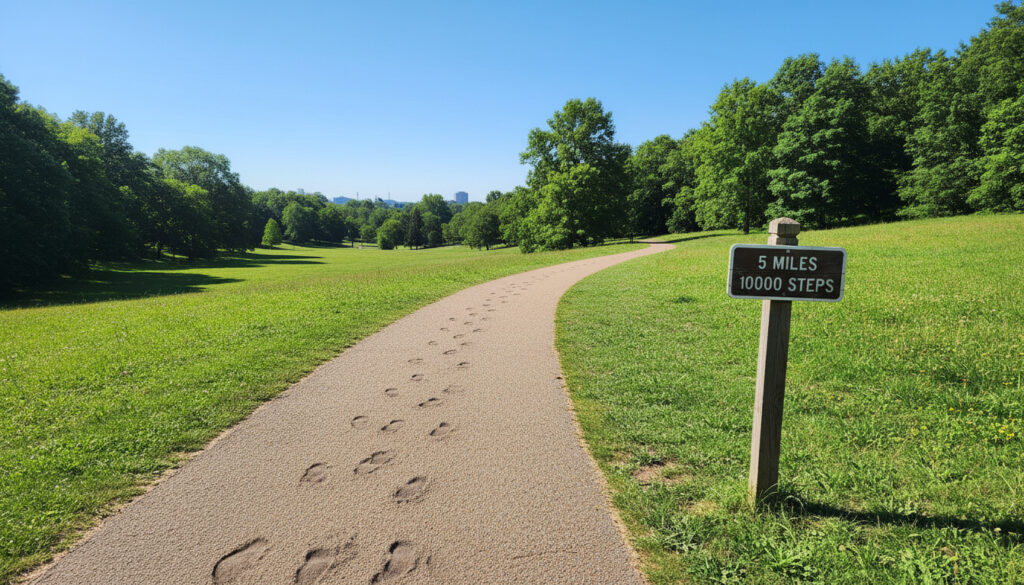
10000 Steps in Miles – How Far You Really Walk
The distance covered by 10,000 steps typically falls between 4 and 5 miles, though the exact measurement depends entirely on individual biomechanics. For women with an average stride length of 2.2 feet, this translates to roughly 4.16 miles, while men averaging 2.5-foot strides cover approximately 4.74 miles over the same step count.
Stride length serves as the critical variable in this conversion, determined by height, gender, walking pace, and whether the activity involves walking or running. Taller individuals naturally achieve greater distances per step, meaning a 6-foot-tall person covers significantly more ground than someone measuring 5 feet, despite identical step counts on their fitness tracker.
Understanding these variables matters for accurate fitness tracking. Uncalibrated pedometers often default to generic averages that may misrepresent actual distance traveled by 10-20%, particularly for individuals whose physical dimensions differ substantially from population norms used in standard algorithms.
How Many Miles is 10,000 Steps?
4–5 miles (6.5–8 km)
2.1–2.5 ft average
Height & Gender
Japanese Manpo-kei (1965)
Standard conversion calculations rely on stride length averages drawn from population studies. However, individual variation creates measurable differences in total distance accumulated during daily step goals.
- Gender divergence: Women average 2.2-foot strides yielding ~4.16 miles per 10,000 steps, while men’s 2.5-foot strides produce ~4.74 miles.
- Height correlation: Each inch of height typically adds measurable distance per step through mechanical leverage and limb length.
- Pace adjustments: Brisk walking (4 mph) increases stride length by approximately 8% compared to casual strolling.
- Activity modality: Running generates 1,400–1,700 steps per mile versus 2,000–2,500 for walking, dramatically altering distance calculations.
- Measurement accuracy: GPS-calibrated devices reduce error margins to under 5% compared to uncorrected accelerometer estimates.
- Terrain impact: Uphill gradients shorten effective stride by 5-15% depending on incline severity.
- Historical context: The 10,000-step target originated as a marketing translation for Japanese “Manpo-kei” pedometers, not clinical research.
Precise conversion requires referencing anthropometric data. The following table illustrates how height determines stride length and resulting mileage for the 10,000-step standard:
| Height | Average Stride | 10,000 Steps Distance |
|---|---|---|
| 5’0″ (152 cm) | 2.1 ft | ~3.98 miles |
| 5’4″ (163 cm) | 2.2 ft | ~4.17 miles |
| 5’8″ (173 cm) | 2.5 ft | ~4.73 miles |
| 6’0″ (183 cm) | 2.7 ft | ~5.11 miles |
| 6’2″ (188 cm) | 2.8 ft | ~5.30 miles |
How to Convert Steps to Miles Accurately
Accurate conversion demands moving beyond generic assumptions to personalized measurement. The fundamental formula divides total steps by the number of steps required to cover one mile, which varies inversely with stride length.
The Mathematics of Conversion
Standard conversion follows the equation: Miles = (Steps × Stride Length in Feet) ÷ 5,280. For a woman measuring 5 feet 4 inches, the calculation applies a 2.2-foot stride: (10,000 × 2.2) ÷ 5,280 = 4.17 miles.
Height-based formulas provide stride estimates without direct measurement. For women: multiply height in inches by 0.413, then divide by 12 to yield stride length in feet. Men use a slightly different multiplier of 0.415. A 5-foot-3-inch woman (63 inches) thus calculates: 63 × 0.413 = 26.02 inches, or 2.17 feet per stride.
Measure a known distance of 20 feet, walk it while counting steps, then divide 240 inches by your step count to determine exact stride length in inches. This eliminates the 10-15% error common with default fitness tracker settings.
Digital Calculation Tools
Specialized calculators incorporate pace multipliers to refine estimates. Slow walking (2 mph) applies a 0.95 correction factor to base stride length, average walking (3 mph) uses 1.0, and brisk walking (4 mph) applies 1.08. Omni Calculator’s steps-to-miles converter automates these adjustments using gender-specific defaults while allowing custom stride input.
Alternatively, Motion App’s walking calculator integrates height formulas with pace adjustments to generate personalized mileage estimates without manual mathematics.
Factors That Affect Your Steps-to-Miles Conversion
Biomechanical and environmental variables introduce significant variance into step-distance relationships. Understanding these factors prevents the frustration of missed distance goals despite achieving target step counts.
Biometric Influences
Height operates as the primary determinant of stride length through simple mechanical geometry. Longer femurs and tibias create wider arcs of motion, directly translating to greater ground coverage per step cycle. Gender differences emerge primarily from average height disparities rather than distinct gait patterns, though pelvic structure contributes marginally to stride variance.
Age subtly reduces stride length through decreased joint flexibility and muscle elasticity, typically shortening steps by 1-2% per decade after age 50. Weight influences efficiency but not necessarily length; heavier individuals may maintain similar strides while expending greater energy.
Pace and Gait Dynamics
Walking velocity directly modulates stride length. As pace increases from 2 mph to 4 mph, natural biomechanics shift from short, frequent steps to longer, less frequent strides. This phenomenon explains why brisk walkers covering 10,000 steps might log 5.2 miles compared to 4.4 miles for casual strollers, despite identical step counts.
Activity Type Distinctions
Running biomechanics differ fundamentally from walking. The aerial phase characteristic of running strides—where both feet leave the ground simultaneously—extends horizontal displacement per step significantly. Calculator data indicates running requires only 1,400–1,700 steps per mile compared to 2,000–2,500 for walking. Consequently, 10,000 running steps yield approximately 6 miles rather than the standard 4-5.
Environmental and Terrain Variables
Surface topography alters effective stride length through mechanical compensation. Uphill gradients necessitate shorter steps to maintain balance and reduce joint impact, typically decreasing stride by 5-8% on moderate inclines. Downhill walking paradoxically may lengthen strides but increases braking forces, altering the metabolic cost without necessarily increasing distance proportionally.
Is 10,000 Steps a Realistic Daily Goal?
The 10,000-step target originated not from medical research but from 1965 Japanese marketing. The Manpo-kei (“10,000 steps meter”) launched by Y. Hatano capitalized on the Japanese character for 10,000 resembling a person walking, creating a memorable health campaign that eventually became global standard.
Contemporary health organizations including the CDC and WHO recommend 150 minutes of moderate activity weekly. For most adults, 10,000 steps approximates 4-5 miles of walking, satisfying these guidelines when performed at moderate intensity. However, recent epidemiological research suggests health benefits begin accumulating at substantially lower step counts—approximately 4,000–5,000 steps daily—with diminishing returns plateauing around 7,500 steps for many populations.
While 10,000 steps provides a convenient benchmark equivalent to roughly 30 minutes of daily walking plus normal activity, individual fitness levels determine appropriate targets. Sedentary individuals benefit from incremental increases rather than immediate adoption of the full 4-5 mile daily requirement.
Distance matters more than step count for specific training outcomes. A 4-mile walk at brisk pace generates greater cardiovascular stimulus than 5 miles of intermittent, slow indoor walking, despite lower step totals.
Timeline: The Evolution of Step Counting
-
Manpo-kei Development: Japanese pedometer inventor Y. Hatano markets the “10,000 steps meter,” establishing the daily target as a cultural norm rather than clinical prescription.
-
Western Adoption: Step counters enter American and European fitness markets, maintaining the 10,000-step default without scientific validation studies.
-
Integration with Guidelines: Health organizations begin referencing step counts as accessible activity metrics, though maintaining minute-based primary recommendations.
-
Smartphone Accelerometers: Built-in step tracking democratizes monitoring, though early algorithms lack stride calibration, producing significant distance errors.
-
GPS Calibration Era: Wearables incorporate satellite positioning and machine learning stride detection, reducing conversion errors to under 3% for calibrated devices.
Established Facts vs. Persistent Uncertainties
Confirmed Parameters
- Mathematical formula: steps × stride ÷ 5,280 = miles
- Height correlates directly with stride length (r > 0.85)
- Men average 12-15% longer strides than women
- Running generates 30-40% greater distance per step than walking
- 10,000 steps equals 4-5 miles for 90% of adults
Variable Factors
- Exact calorie expenditure without weight/pace data
- Health benefits specific to 10,000 vs. 7,500 steps
- Stride degradation rates for elderly populations
- Terrain impact on joint loading vs. distance accuracy
- Individual metabolic responses to equivalent distances
The Origin and Cultural Significance of 10,000 Steps
The persistence of 10,000 steps as a health benchmark reflects marketing longevity rather than physiological optimization. The Japanese Manpo-kei campaign successfully embedded the number into global consciousness during the 1964 Tokyo Olympics fitness boom, creating a round-number target that proved memorable and achievable for the average Japanese adult of that era.
Western medical institutions later adopted the standard because it approximates 30 minutes of daily walking plus baseline activity, aligning roughly with 150-minute weekly exercise guidelines. However, the specific 10,000 figure lacks empirical superiority over 8,000 or 12,000 steps for most health outcomes. The number’s persistence stems from its successful translation into English-language fitness culture during the 1980s aerobics movement, where it provided a quantifiable alternative to time-based exercise prescriptions.
Modern pedometer calibration guidelines acknowledge this arbitrary origin while recognizing the goal’s utility as a behavioral anchor for sedentary populations transitioning toward active lifestyles.
Sources and Methodology
Distance calculations derive from biomechanical studies cited in peer-reviewed stride length databases and anthropometric research from Lowell Running and Motion App. Height-to-stride formulas originate from regression analysis of population gait studies.
“Stride length calculation requires individualized measurement over assumed averages. Population means vary by 20% between 5th and 95th percentiles for height-matched cohorts.”
“Pedometer accuracy improves significantly when users input measured stride lengths rather than accepting default values based on height and gender alone.”
— The Calculator Site Health Metrics
Key Takeaways
Ten thousand steps translates to 4-5 miles for most adults, with precise distance determined by individual stride length varying between 2.1 and 2.8 feet. Accurate tracking requires either personal stride measurement using the 20-foot calibration method or height-based formulas adjusted for walking pace. While the 10,000-step target originated as Japanese marketing rather than medical science, it approximates modern cardiovascular health guidelines when maintained consistently. For related health metrics, see How to Work Out BMI.
Frequently Asked Questions
How far is 10,000 steps in kilometers?
Based on standard conversions, 10,000 steps equals approximately 6.5 to 8 kilometers. Using the average of 4.4 miles and the conversion factor of 1.609 kilometers per mile, the distance calculates to roughly 7.1 kilometers for average-height walkers.
Can I calculate calories burned from the miles equivalent?
Yes, using the formula: Calories ≈ Miles × Weight (lbs) × 0.57 for walking. A 160-pound person walking 4.4 miles burns roughly 400 calories, though pace and terrain introduce variance.
What changes if I run 10,000 steps instead of walking?
Running 10,000 steps covers approximately 6 miles rather than 4-5, due to longer aerial strides. Running strides average 1,400-1,700 steps per mile compared to 2,000-2,500 for walking.
Does walking uphill affect the miles calculation?
Uphill walking typically reduces effective stride length by 5-15%, meaning 10,000 steps covers less horizontal distance despite identical vertical work. GPS devices measure actual ground distance rather than step estimates.
How accurate are smartphone pedometers for distance?
Uncalibrated smartphone accelerometers assume default stride lengths, potentially creating 10-20% errors. Accuracy improves substantially when users input measured stride data or enable GPS tracking.
Is the 10,000 step goal scientifically proven?
The specific number originated from 1960s Japanese marketing rather than clinical trials. However, current research supports 7,000-8,000 steps daily for significant health benefits, with 10,000 providing additional but diminishing returns.
More related posts
 Cast of The Iron Claw: Full List and Von Erich Roles
 Jamie Oliver Eat Yourself Healthy: Cookbook & TV Series Guide
 James Norton Movies and TV Shows – Full Filmography and Best Roles
 Turkey Travel Warning: Paragliding Safety Risks
 St Johns Wood Station: Jubilee Line Guide, Zone 2 Tube Info
 Hull City v Oxford United: Prediction, Stat & Head-to-Head
 Cho Chang: Biography, Actress Katie Leung, Controversies
 Antony Gormley: Biography, Famous Works, and Sculptures
