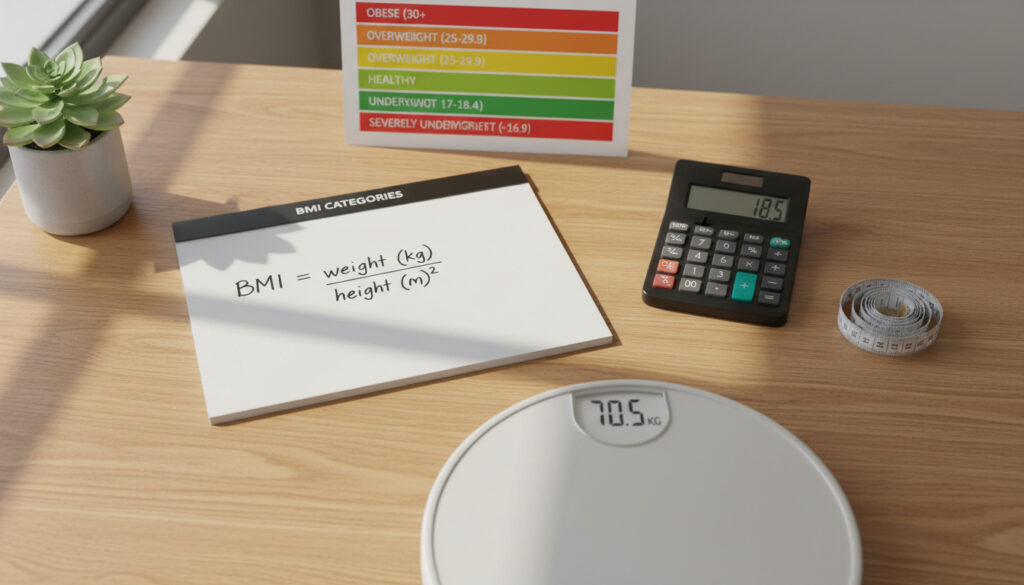
How to Work Out BMI – Formulas, Categories and Guide
Body Mass Index (BMI) serves as a widely adopted screening tool that estimates body fat levels using only height and weight measurements. Health professionals employ this metric to identify potential weight-related health risks in adults, offering a standardized method to categorize individuals into underweight, healthy, overweight, or obese classifications.
Despite its simplicity, BMI calculation requires precision regarding measurement units and formula selection. Understanding how to perform this calculation manually—whether using metric or imperial measurements—provides individuals with immediate insight into their health status while highlighting the metric’s specific limitations and appropriate applications.
How Do You Calculate BMI?
BMI calculation requires only two measurements: weight and height. The method differs slightly depending on whether you use metric or imperial units, though both produce identical categorical results.
A screening tool estimating body fat using height and weight ratios derived from population data.
Weight divided by height squared, adjusted by conversion factors for different measurement systems.
Values between 18.5 and 24.9 kg/m² indicate the lowest health risk profiles for adults.
The calculation cannot distinguish between adipose tissue and lean muscle mass.
Key Insights:
- Metric calculations divide kilograms by meters squared, requiring height conversion to meters before mathematical squaring.
- Imperial formulas multiply weight in pounds by 703, then divide by height in inches squared to maintain proportional equivalence with metric results.
- The Centers for Disease Control and Prevention and World Health Organization maintain identical category thresholds regardless of age, gender, or ethnicity for adults over 20.
- Common calculation errors occur when users fail to convert height measurements to the proper units (meters or inches) before performing the squaring operation.
- A person standing 5 feet 9 inches tall weighing 168 pounds sits at the upper boundary of the healthy weight range, while 203 pounds places the same individual in the obesity classification.
- Published charts from the National Heart, Lung, and Blood Institute provide visual reference tables that eliminate manual calculation requirements by intersecting height and weight values.
- Population studies originating in the 19th century established the foundational height-weight ratios that remain in use today.
| Metric Formula | Imperial Formula | Category |
|---|---|---|
| 70 kg ÷ (1.70 m × 1.70 m) = 24.22 | (180 lbs × 703) ÷ (65 in × 65 in) = 29.9 | Underweight: <18.5 |
| Weight (kg) ÷ [Height (m)]² | [Weight (lb) × 703] ÷ [Height (in)]² | Healthy: 18.5–24.9 |
| Example: 50 kg, 1.60 m = 19.5 | Example: 120 lb, 62 in = 21.9 | Overweight: 25.0–29.9 |
| Calculation requires decimal height | Calculation requires total inches | Obesity Class 1: 30.0–34.9 |
| Used by NHS and WHO | Used in US clinical settings | Obesity Class 2: 35.0–39.9 |
| Most common globally | Requires 703 multiplier | Obesity Class 3: ≥40.0 |
What Are the BMI Categories?
Health organizations classify BMI results into distinct categories that correlate with varying levels of health risk. These classifications help identify individuals who may benefit from medical consultation or lifestyle modifications.
What Is a Healthy BMI?
For adults aged 20 and over, a BMI between 18.5 and 24.9 kg/m² represents the healthy weight range associated with the least health risk, according to Diabetes Canada standards.
Understanding the BMI Chart for Adults
Visual charts published by the National Heart, Lung, and Blood Institute simplify classification by allowing users to locate their height along the vertical axis and weight across the horizontal axis, reading the intersecting BMI value directly. These tables typically shade regions to indicate underweight, healthy, overweight, and obese zones.
BMI for Men vs Women
Despite women typically carrying higher percentages of body fat than men at equivalent BMI values, health authorities apply identical category charts to both genders. The Cleveland Clinic notes that no gender-specific adjustments exist in standard BMI calculations, though this represents a documented limitation in the metric’s precision.
BMI Ranges for Children
Pediatric assessment requires separate methodologies. The CDC specifies that children and adolescents should not use adult BMI categories; instead, healthcare providers utilize BMI-for-age percentile charts that account for growth patterns and developmental stages.
Adults aged 20 and older use universal category thresholds that do not adjust for gender or race. Children require specialized percentile charts rather than fixed BMI categories.
How Accurate Is BMI?
While BMI provides a useful population-level screening tool, its accuracy for individual assessment varies significantly based on body composition and demographic factors.
What Is BMI?
Developed from 19th-century actuarial data, BMI functions as a simple height-weight ratio originally designed for population studies rather than individual diagnosis. The metric categorizes individuals based on the ratio of weight to height squared, offering a standardized but generalized assessment of body fat.
Limitations of BMI
The American Association of Clinical Endocrinology and major medical institutions identify several critical constraints. BMI fails to differentiate between adipose tissue and lean muscle mass, classifying muscular athletes as overweight or obese despite low body fat percentages. The metric applies identical categories to men and women despite known differences in body composition, and does not account for modern height trends or age-related changes in body mass distribution.
BMI functions solely as a screening tool and cannot diagnose individual health status. Medical professionals recommend combining BMI results with additional health factors and clinical assessments for accurate evaluation. For a more precise understanding of body composition, consider using a BMI calculator, which can be found at $5ft 11in to cm conversion.
Individuals with high lean muscle mass, including athletes and bodybuilders, often receive elevated BMI classifications that inaccurately reflect body fat percentage. Alternative measurement methods may provide more relevant health data for these populations.
Research published in Medical News Today confirms that obesity classifications begin at 30.0 kg/m², with severe obesity marked at 35.0 kg/m² and above, though these thresholds may not account for individual metabolic health variations.
How Did BMI Develop Over Time?
The evolution of Body Mass Index spans nearly two centuries, transforming from actuarial tables into a global health standard.
- : Belgian mathematician Adolphe Quetelet develops the Quetelet Index using actuarial data to establish height-weight relationships in populations, laying the groundwork for modern BMI calculations.
- : Researchers formally coin the term “Body Mass Index” (BMI) to replace the original Quetelet nomenclature, establishing the modern terminology still used today.
- : The World Health Organization establishes standardized BMI categories—underweight, overweight, and obesity thresholds—for international health monitoring and epidemiological research.
- Today: Digital calculators and smartphone applications automate calculations previously performed manually using printed reference tables, increasing accessibility while maintaining the original mathematical formulas rooted in 19th-century population studies.
What Does BMI Definitively Reveal?
Understanding the boundaries between established scientific consensus and ongoing uncertainty helps interpret BMI results appropriately.
| Established Information | Information That Remains Uncertain |
|---|---|
| Category thresholds (18.5, 25, 30 kg/m²) are standardized for adults 20+ regardless of race or gender | Optimal BMI ranges for elderly adults over 65 years |
| Metric and imperial formulas produce identical categorical classifications when calculated correctly | Specific health risk variations across different ethnic groups at identical BMI values |
| Children require BMI-for-age percentile charts rather than adult category cutoffs | Precise muscle-to-fat ratios in individual bodies using only height and weight |
| Values above 30 kg/m² correlate with increased health risks in population studies | Long-term outcomes for individuals at exact category boundary values |
What Is BMI and Where Did It Originate?
Body Mass Index represents a screening metric developed from 19th-century population studies. Originally derived from actuarial data collected by Belgian statistician Adolphe Quetelet, the index established mathematical relationships between height and weight across large population samples. The methodology prioritized simplicity, requiring only basic measurements without specialized equipment.
The metric gained widespread adoption throughout the 20th century as public health organizations sought standardized methods to track obesity trends and associated health risks. By the 1990s, the World Health Organization had formalized the category thresholds now used globally, enabling consistent data collection across different countries and demographic groups.
Today, medical professionals view BMI as a preliminary screening tool rather than a diagnostic instrument. While useful for identifying population-level trends and flagging individuals who may require further assessment, the metric serves best when combined with additional clinical evaluations including waist circumference measurements, body composition analysis, and metabolic health markers. For those interested in how public figures maintain physical fitness for demanding roles, James Norton Movies and TV Shows – Full Filmography and Best Roles provides insight into the physical preparation required for various character portrayals.
How Do Leading Health Authorities Define BMI?
The World Health Organization utilizes BMI as a population-level indicator to track adult underweight, overweight, and obesity prevalence, defining underweight as below 18.5 kg/m², overweight as 25 kg/m² or higher, and obesity as 30 kg/m² or higher.
World Health Organization Global Health Observatory
BMI represents a useful measure for most adults, calculated by dividing weight in kilograms by height in meters squared, providing a general indication of whether weight falls within healthy ranges.
National Health Service BMI Calculator Guidance
Understanding Your BMI Calculation
Understanding how to work out BMI provides individuals with a standardized method to assess weight status using basic measurements. While the metric calculation—whether performed using metric or imperial formulas—offers immediate categorization into underweight, healthy, overweight, or obese classifications, users should recognize its limitations regarding muscle mass differentiation and demographic variations. For comprehensive health assessment, combine BMI results with clinical evaluations and consider exploring lifestyle resources like Best TV Shows 2024 – Top Rated on Rotten Tomatoes to support overall wellbeing through balanced leisure activities.
Frequently Asked Questions
How do you calculate BMI without a calculator?
Multiply your weight in pounds by 703, then divide by your height in inches squared. Alternatively, divide kilograms by meters squared. Use paper and pencil following these formula steps.
Why is BMI different for children?
Children require BMI-for-age percentile charts rather than adult categories because their bodies change rapidly during growth. Adult fixed thresholds do not account for developmental stages.
Can BMI distinguish between muscle and fat?
No. BMI treats all weight equally, meaning muscular athletes may register as overweight despite low body fat. Additional body composition testing is required to differentiate tissue types.
What BMI range indicates obesity?
Adults with BMI values of 30.0 kg/m² or higher fall into obesity classifications, with subclasses ranging from Class 1 (30.0–34.9) to Class 3 (40.0 and above).
Is the BMI formula identical worldwide?
Yes. The mathematical calculation remains constant globally, though interpretation categories may vary slightly between organizations. WHO and CDC standards are widely adopted internationally.
How did BMI get its name?
Researchers coined the term “Body Mass Index” in 1972 to replace the original “Quetelet Index,” named after its 19th-century creator, while maintaining the same mathematical foundation.
More related posts
 DPD Drop Off Point: Find & Use Pickup Locations in Ireland
 James Norton Movies and TV Shows – Full Filmography and Best Roles
 Legends of the Fall – Plot Cast Ending and Where to Watch
 How to Make Garlic Bread – Step-by-Step Home Guide
 Harry Potter Birthday Cake: Recipe, Frosting & Where to Buy
 Marc Cucurella: Biography, Transfer News & Fan Views
 How to Program TV Remote – Step-by-Step Guide
 Anthony Joshua Next Fight – Dubois KO Win at Wembley
