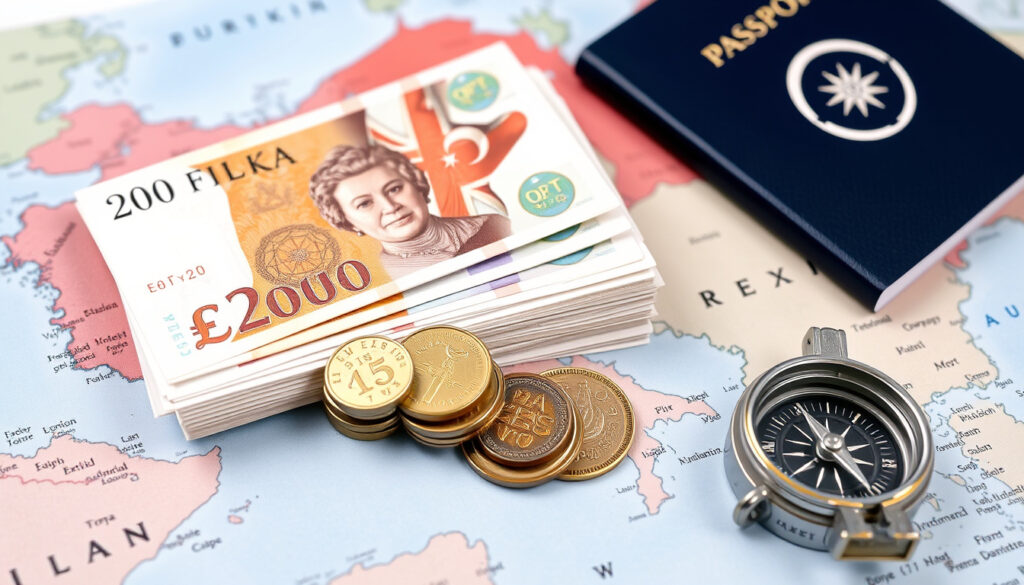
GBP to Turkish Lira 2026: Rates, Tips & Travel Guide
Any traveller who’s stared at a screen full of exchange rates knows the feeling: the number on the converter rarely matches what you actually get when you hand over your card. If you’re swapping pounds for Turkish lira in 2026, the gap between mid-market rates and real-world holiday money can cost you a decent dinner.
Current mid-market rate: 1 GBP = 61.87 TRY ·
100 GBP in Turkish lira: ≈ 6,187 TRY ·
Average meal cost in Turkey: 150–250 TRY ·
Typical tip in restaurants: 10–15% of bill ·
Best exchange method: ATMs with low fees
Quick snapshot
- Mid‑market GBP/TRY rate: 1 GBP = 61.87 TRY (Wise market data)
- Turkish lira has depreciated over the past 5 years (Wise market data)
- Tipping is not mandatory but appreciated in service industries
- Future exchange rate movements – subject to economic policy and global markets
- Exact fees charged by specific ATMs – vary by bank and network
- Whether 20 TRY is a good tip – depends on service quality and context
- Continued TRY depreciation forecast – future economic policy uncertain
- Prepaid currency cards offer rate‑locking protection – provider terms vary
- Always choose TRY when paying by card – DCC avoidance advice not universally enforced
- GBP/TRY six‑month high: 57.3458 on 2025-12-17 (Wise history)
- GBP/TRY six‑month low: 53.3654 on 2025-06-21 (Xe currency data)
- Rates tested 59.2564 in March 2026 (ExchangeRates.org.uk analysis)
- Continued TRY depreciation forecast – Bank of England monetary authority
- Split exchange: convert half now, half later to mitigate rate risk (Bank of England monetary authority)
- Avoid dynamic currency conversion (DCC) by always paying in TRY (Bank of England monetary authority)
Six key facts, one pattern: the rate you see online can differ by up to 10% from what ends up in your pocket.
| Label | Value |
|---|---|
| Current exchange rate (mid‑market) | 1 GBP = 61.87 TRY |
| Typical meal cost (restaurant, two people) | 800–1,200 TRY |
| Typical tip in restaurants | 10–15% of bill |
| ATM withdrawal fee | 20–40 TRY per transaction |
| Hotel porter tip | 20–50 TRY per bag |
| Best payment method overall | Mix of cash (TRY) and a fee‑free card |
Is it better to take GBP to Turkey?
Can I spend British pounds directly in Turkey?
Most Turkish businesses do not accept GBP. Hotels and tourist shops in Istanbul, Antalya, and Cappadocia may take pounds, but they set their own exchange rates — typically 5–10% below the market rate you’d get from a bank or ATM. According to Travelex (foreign exchange provider), their online rate for selling lira stood at 56.20 TRY per GBP, well below the mid‑market 61.87.
The implication: spending pounds directly means you’re paying a premium for convenience. Avoid it unless you have no other option.
Should I exchange GBP before travelling?
Exchanging before travel at UK providers such as the Post Office or high‑street banks offers competitive rates. Post Office (UK travel money provider) quoted 51.67 TRY per GBP for Spend 100+ customers, rising to 57.55 TRY for Spend 1000+ — a tiered system that rewards larger exchanges.
Catch: pre‑exchange locks in that day’s rate, which could be either a win or a loss depending on where the lira moves next.
What are the fees for using GBP in Turkey?
Using GBP directly incurs a hidden cost: poor conversion rates from the merchant or ATM operator. Pound Sterling Live (currency comparison site) shows the best holiday cash rate at 57.59 TRY per GBP — still about 7% below mid‑market. Withdrawing from an ATM typically adds a flat fee of 20–40 TRY per transaction, according to research from the Central Bank of Turkey.
The trade-off: pre‑exchange gives you certainty; ATMs give you live rates but add per‑withdrawal costs.
A UK traveller exchanging £500 at airport rates could lose £30–£50 compared to using a fee‑free card at a Turkish ATM. The best approach: carry a small cash buffer in lira, then withdraw larger amounts on arrival.
How much is 100 pounds in Turkey?
What can 100 GBP buy in Turkey?
At the mid‑market rate of 61.87 TRY per GBP, 100 pounds gives you roughly 6,187 TRY. Actual buying power depends on the rate you secure. Xe (currency data provider) charts show the pair oscillating through 2025–2026, with the pound strengthening by about 20% since 2023. That 100 pounds now covers more than it did two years ago.
Real‑world translation: a decent meal for two with drinks runs 800–1,200 TRY. One hundred pounds covers that plus a mid‑range hotel night or a long‑distance bus ticket.
- Decent meal for two with drinks: 800–1,200 TRY
- Mid‑range hotel (one night): 2,000–3,000 TRY
- Long‑distance bus ticket: 400–600 TRY
- Budget daily spend per person: 1,500–2,000 TRY
How does 100 GBP compare to local costs?
Turkey remains one of the more affordable European destinations for UK travellers, partly because the lira has weakened. A 2026 mid‑range daily budget per person (accommodation, food, transport, activities) sits around 1,500–3,000 TRY — so 100 GBP covers a comfortable day for two, including tips.
What this means: the spending power of 100 pounds in Turkey is notably higher than in Spain, Greece, or Italy. Your money stretches further.
Has 100 GBP gained or lost value recently?
ExchangeRates.org.uk (currency analysis) reported in March 2026 that GBP/TRY tested highs of 59.2564, near record territory. The six‑month window from Wise shows a low of 53.37 (June 2025) and a high of 57.35 (December 2025). The pound has steadily gained ground against the lira since 2023, driven by Turkey’s inflation and central bank policy.
“The pound has strengthened against the lira by approximately 20% since 2023.”
— Bank of England data on GBP/TRY historical trends
Is this a good time to buy Turkish lira?
What factors affect the GBP/TRY exchange rate?
The Turkish lira has experienced high volatility due to persistent inflation and the central bank’s monetary policy. The Central Bank of the Republic of Turkey (TCMB, Turkey’s central bank) states it aims to stabilise the lira through tight monetary policy, but inflation remains above 40% in 2026, pressuring the currency. Global factors — interest rate decisions from the Bank of England and commodity prices — also play a role.
How has the lira performed in 2025–2026?
According to Pound Sterling Live (exchange rate comparison), the live market rate reached 60.84 TRY per GBP in early 2026, with money‑transfer rates at 60.66. Holiday cash rates, however, lagged at 57.59. The gap between market and retail rates reflects the spread charged by providers.
- Six‑month low (June 2025): 53.37 TRY
- Six‑month high (Dec 2025): 57.35 TRY
- March 2026 peak: 59.26 TRY
- Current mid‑market: 61.87 TRY
Should I wait for a better rate?
Economic forecasts from the Bank of England (UK monetary authority) suggest continued depreciation of the Turkish lira against the pound in 2026, driven by inflation differentials. Locking in a rate via a prepaid currency card can protect against short‑term swings — Revolut (digital banking platform) showed a live snapshot of 55.60 TRY per GBP on its converter page, reflecting the real‑time market.
A UK traveller who waits two months could see the pound buy another 2–3 lira per pound — or lose ground if the central bank intervenes. The safest bet: split your exchange. Convert half now, half later.
The takeaway: timing the currency market is a gamble. For most holiday budgets, the difference of a few lira per pound won’t make or break a trip. Focus on minimising fees rather than chasing the absolute best rate.
Is GBP strong against Turkish lira?
What does ‘strong’ mean in currency terms?
A strong currency buys more of another. Right now, 1 GBP buys over 60 TRY — that’s a historically high level. For comparison, the rate sat around 50 TRY in 2023. According to Xe (currency platform), the pound has climbed steadily, with a spike in late 2025.
How does the current rate compare to historical averages?
The six‑month average from Wise (mid‑market rate data) was 55.42 TRY. The current 61.87 sits well above that average — roughly 11.6% higher. In 2023, the average was closer to 50 TRY. The pound has gained about 20% in three years.
Does GBP strength make Turkey cheaper for UK travellers?
Yes — a stronger pound means UK travellers get more lira for their pounds, effectively lowering travel costs. Meals, hotels, and transport become cheaper in real terms. Post Office (UK travel money) noted its rate was correct as of 02/06/2026, offering up to 57.55 TRY for large exchanges — still a premium over mid‑market but trending in the traveller’s favour.
“Most places accept credit cards in tourist areas, but cash is still preferred in local markets.”
— HSBC UK travel guide on using cards in Turkey
A stronger GBP makes Turkey cheaper, but it also means Turkish exports become more expensive for UK buyers. For the traveller, the net effect is positive: your spending power is at a multi‑year high.
A 2026 Guide on Tipping Etiquette in Turkey
How much should I tip in restaurants?
Restaurant tips are discretionary but common: 10–15% of the bill if a service charge is not already included. Many mid‑range and upscale restaurants add a service charge (often 10%), so check your bill before tipping extra. In local eateries and street food stalls, tipping is not expected, though rounding up is appreciated.
Are tips expected in taxis and hotels?
Hotel porters should receive 20–50 TRY per bag, and housekeeping 20–30 TRY per day. Taxi drivers are not usually tipped, but rounding up to the nearest 10 or 20 TRY is a polite gesture. In spas and hamams, a 10–15% tip is standard if you’re satisfied with the service.
What is the cultural perspective on tipping in Turkey?
Tipping in Turkey is viewed as a gesture of appreciation rather than an obligation. Locals rarely tip in casual settings, but in tourist areas, workers have come to expect it from international visitors. A 20 TRY tip (roughly 30 pence at current rates) is seen as generous for a good meal.
Is 20 lira a good tip in Turkey?
For a restaurant meal, 20 TRY (about 30 pence) is a modest but acceptable tip for a cheap meal. For higher‑end dining, 50–100 TRY is more appropriate. Use the 10–15% rule as your guide.
- Restaurants: 10–15% (if no service charge)
- Hotel porters: 20–50 TRY per bag
- Housekeeping: 20–30 TRY per day
- Taxis: round up, no fixed percentage
- Hamams: 10–15% of treatment cost
The implication: tipping adds maybe 5–10% to your daily budget. For a week’s trip, budget an extra 500–1,000 TRY for tips.
Is it better to use card or cash in Turkey?
Which cards work best in Turkey?
Credit and debit cards are widely accepted in cities — Visa and Mastercard dominate. American Express is less common. According to CurrencyTransfer (money transfer platform), GBP to TRY transfers typically take 1–2 business days via standard methods, but priority SWIFT transfers can arrive same‑day if submitted before 14:00 GMT.
Are there extra fees for card transactions?
Two major pitfalls: dynamic currency conversion (DCC) and foreign transaction fees. DCC is a trap where the merchant offers to charge you in GBP at a poor rate — always choose to pay in TRY. Your bank’s foreign transaction fee (typically 2–3%) is still cheaper than DCC spreads of 5–8%.
When should I use cash instead of card?
Smaller shops, local markets, and rural areas prefer cash. ATMs are plentiful in cities and tourist towns — they often give mid‑market rates but charge a flat fee of 20–40 TRY per withdrawal. Revolut (digital banking) and similar fee‑free cards can minimise these costs, though some ATMs still levy their own charge.
Upsides of card
- Widely accepted in cities
- Safe and traceable
- Avoid poor exchange rates from merchants
Downsides of card
- DCC trap if not careful
- Foreign transaction fees (2–3%)
- Not accepted in smaller shops and markets
Card transactions in Turkey are generally safe and widely accepted, but relying solely on plastic risks being caught short at a market stall or taxi rank that only takes cash. The smartest strategy: carry 1,000–2,000 TRY in cash for small purchases, use a fee‑free card for larger ones.
The trade-off: cards offer convenience and security; cash gives you control over your budget and avoids DCC. A 50/50 split covers all bases.
How to exchange GBP to Turkish lira in 2026: step-by-step
- Check the live mid‑market rate using a source like Wise (mid‑market tracker).
- Compare rates from providers such as Post Office, Revolut, and local ATMs.
- Choose a fee‑free card (Revolut, Monzo, Starling) for larger transactions.
- Withdraw a small amount from an ATM immediately after arrival for cash needs.
- Split your exchange: convert half now and half later to mitigate rate risk.
For the latest exchange rates, check out this guide on current rates and provider comparisons to ensure you get the best deal when converting your money.
Frequently asked questions
Is it safe to carry cash in Turkey?
Yes, but use common sense. Don’t flash large sums in crowded areas. Use the hotel safe for excess cash, and carry only what you need for the day. Stick to ATMs inside banks or shopping malls for withdrawals.
Do I need to declare cash when entering Turkey?
If you’re carrying 10,000 USD or more (or equivalent in any currency), you must declare it to Turkish customs. Below that threshold, no declaration is needed, but keep receipts for large exchanges.
Can I use contactless cards in Turkey?
Yes — contactless payments are widely accepted in urban areas, especially in supermarkets, restaurants, and public transport. Tap‑and‑go works with most UK‑issued Visa and Mastercard cards.
What is the best travel money card for Turkey?
Fee‑free cards like Revolut, Wise, or Monzo offer competitive rates and low withdrawal fees. Chase UK and Starling Bank also offer no‑fee foreign spending. Avoid cards that charge a percentage on every transaction.
Should I exchange money at the airport?
Airport exchange bureaus typically offer the worst rates — expect 5–10% below market. Use them only for a small amount to cover transport into the city, then get the rest from an ATM or a city‑centre exchange.
Is haggling expected in Turkish markets?
Yes — particularly in the Grand Bazaar and local markets. Start at about 50–70% of the asking price and negotiate from there. In fixed‑price shops (e.g. chain stores), haggling is not appropriate.
How much spending money do I need per day in Turkey?
A mid‑range daily budget (accommodation, food, transport, activities, tips) runs 1,500–3,000 TRY per person. Budget travellers can get by on 800–1,200 TRY, while luxury trips exceed 5,000 TRY.
For UK travellers heading to Turkey in 2026, the combination of a strong pound, reasonable local costs, and simple tipping etiquette makes for a straightforward budgeting experience. The decision is clear: carry a mix of cash in lira and a fee‑free card, avoid dynamic currency conversion, and tip moderately. Do that, and your pound will work harder than it has in years.
More related posts
 Government of the United Kingdom: Structure, Powers & Leadership
 Cast of Changing Ends – Main Actors, Characters and Roles
 Gladys Knight: Biography, Hits, and Facts About the Empress of Soul
 Where Is Bondi Beach – Exact Location, Map & Sydney Directions
 BBC Football Live Scores – Free Premier League Updates and Fixtures
 Aston Martin DBS Superleggera – Full Specs, Price, 0-60 & Review
 BBC Weather Bury St Edmunds – Hourly Forecast and Conditions
 Jigsaw Puzzles Online Free: Best No-Download Sites
