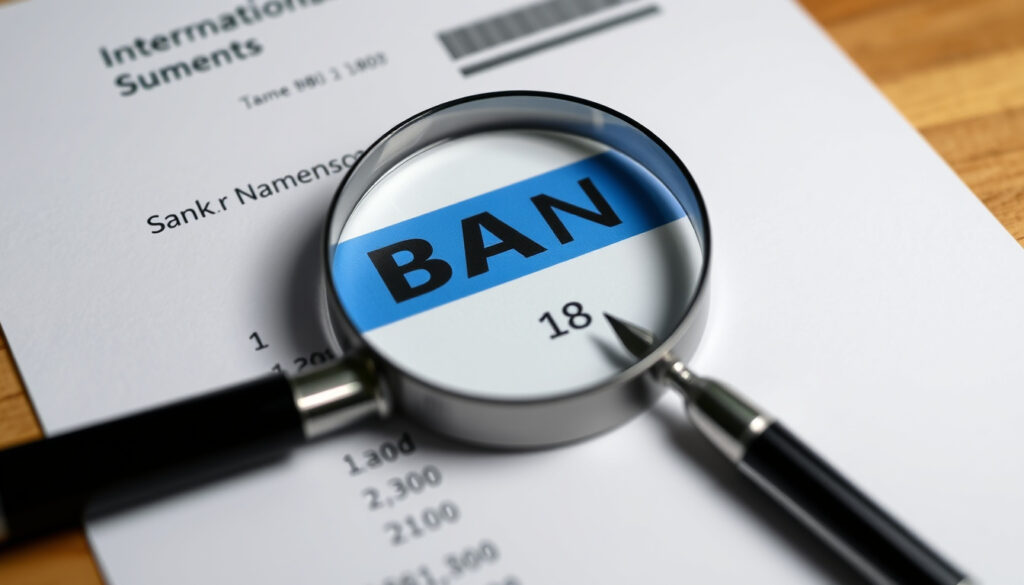
What is an IBAN Number? Meaning, Structure, and How to Find It
Few things are more frustrating than trying to send money abroad and suddenly needing a code you’ve never heard of. The IBAN — International Bank Account Number — is that code.
Maximum characters: 34 ·
Countries using IBAN: Over 70 ·
ISO standard: ISO 13616 ·
Introduced: 1997
Quick snapshot
- IBAN is an internationally agreed standard (SWIFT (global banking standards body))
- Up to 34 alphanumeric characters (Wikipedia (open encyclopedia))
- Required for SEPA transfers (IBAN.com (official IBAN registry))
- Whether all non-SEPA countries will eventually adopt IBAN (Bank.Codes (IBAN reference site))
- Exact maximum length varies by country; not every country uses 34 characters (Bank.Codes (IBAN reference site))
- The exact timeline for IBAN adoption in non-SEPA regions is not yet defined (Bank.Codes (IBAN reference site))
- ISO 13616 standard introduced in 1997 by the International Organization for Standardization
- Rapid adoption across Europe after SEPA regulation in 2014
- Continued adoption in Middle East, Africa, and parts of Asia
- Possible integration with instant payment systems like the UK’s Faster Payments
Here is a quick overview of IBAN key facts.
| Attribute | Details |
|---|---|
| Full name | International Bank Account Number |
| Standard | ISO 13616 |
| Maximum length | 34 characters |
| Countries using IBAN | Over 70 |
| Example (UK) | GB29NWBK60161331926819 |
| Example (Ireland) | IE29AIBK93115212345678 |
What is an IBAN number?
IBAN meaning and definition
- IBAN stands for International Bank Account Number, a standard developed by SWIFT (global banking standards body) and the International Organization for Standardization.
- It is an internationally agreed code that helps banks process cross-border payments automatically (SWIFT).
- The format is specified by ISO 13616, which defines the structure of a compliant national IBAN (SWIFT).
IBAN structure and components
- An IBAN can contain up to 34 alphanumeric characters, using only digits 0-9 and Latin letters A-Z (Wikipedia (open encyclopedia)).
- The standard structure is: Country code (2 letters, ISO 3166-1 alpha-2) + check digits (2 numbers) + BBAN (Basic Bank Account Number, up to 30 characters) (Bank.Codes (IBAN reference site)).
- The check digits let banks validate the number before processing a transaction (Wikipedia).
- Banks traditionally write IBANs in groups of four characters for readability, but omit spaces during electronic transmission (Wikipedia).
Examples of IBANs
- UK example: GB29NWBK60161331926819 — GB (country code), 29 (check digit), NWBK (bank code), 601613 (sort code), 31926819 (account number) (Wise (financial services platform)).
- Irish example: IE29AIBK93115212345678 — IE (country code), 29 (check digit), AIBK (bank code for AIB), 931152 (NSC sort code), 12345678 (account number) (IBAN.com (official IBAN registry)).
The IBAN isn’t just a random string — it’s a checksum-protected identifier that prevents your payment from landing in the wrong account. For anyone sending money across borders regularly, understanding the structure is the first line of defence.
The implication: a single typo in the check digits usually blocks the transfer, saving you from costly errors.
Is an IBAN number the same as a bank account number?
Difference between IBAN and standard account number
- No — your domestic account number is only part of your IBAN (Stripe (payments infrastructure provider)).
- An IBAN adds a country code, two check digits, and sometimes bank routing information. A domestic account number lacks these extras (Bank.Codes).
- In the UK, the IBAN includes your sort code and account number but prefixes them with GB, check digits, and a bank code (Wise).
Why IBAN is not the same as your bank account number
- Your bank account number alone works for domestic transfers. Add the IBAN and the receiving bank can identify your country and verify the number automatically (SWIFT).
- Think of it like a postcode on a letter: the house number (account number) is essential, but without the postcode (country code + check digits) the letter might never arrive.
Six attributes, one clear pattern: IBAN is your account number with international standardisation added on top.
| Feature | IBAN | Bank account number |
|---|---|---|
| Purpose | International transfers | Domestic transactions |
| Length | Up to 34 characters | 6-10 digits (varies by country) |
| Components | Country code, check digits, bank code, account number | Usually just the account number |
| Validation | Built-in check digits | No built-in checksum |
| Usage | Required for SEPA and most cross-border payments | Sufficient for local payments |
Bottom line: An IBAN is your existing account number wrapped in a global standard. For domestic payments, your standard account number is enough. For international transfers, you need the full IBAN.
How do I find out what my IBAN number is?
Check your bank statement
- Your IBAN appears on printed and digital bank statements, usually near the top or in the account details section (Bank of Ireland (Irish retail bank)).
- Look for a string of 22 characters for UK and Irish accounts.
Log in to online banking or mobile app
- Log in to your online banking portal or mobile app.
- Navigate to your account summary or account details page.
- Look for a section labelled “IBAN” or “Account details”.
- Copy the IBAN exactly as shown — it may be grouped in blocks of four.
Use bank’s IBAN calculator tool
- Many banks provide an online IBAN calculator where you enter your sort code and account number to generate your IBAN (Wise offers a free tool).
- Central banks in Ireland and the UK also list IBAN structure details (IBAN.com).
You never need to memorise your IBAN — but you should know where to find it. Every major bank displays it in at least two places: your statement and your online profile. If you can’t spot it, call your bank’s support line.
The pattern: finding your IBAN is straightforward when you know where to look.
What is an IBAN number for the UK?
UK IBAN format and example
- UK IBANs are 22 characters long and always start with GB (IBAN.com).
- The reference example used by Firstmark Credit Union (US financial institution) is GB29NWBK60161331926819.
- Breaking it down: GB (country code) – 29 (check digit) – NWBK (bank code for National Westminster Bank) – 601613 (sort code) – 31926819 (account number) (Wise).
How UK IBANs relate to sort code and account number
- Your UK IBAN is literally your sort code and account number with GB, check digits, and a bank code added at the front (Stripe).
- You do not need a separate IBAN if you only transfer within the UK — your sort code and account number suffice.
- The check digits (29 in the example) help banks catch typos before the transfer is submitted (Wikipedia).
A UK IBAN works seamlessly across Europe thanks to SEPA. But if you’re sending money to a non-SEPA country like the US or Australia, you’ll also need a SWIFT/BIC code — the IBAN alone won’t be enough.
The implication: always have both IBAN and BIC ready for non-SEPA transfers.
What is an IBAN number in Ireland?
Irish IBAN format and example
- Irish IBANs are also 22 characters and start with IE (IBAN.com).
- A typical example is IE29AIBK93115212345678 — IE (country code), 29 (check digit), AIBK (bank code for Allied Irish Banks), 931152 (NSC sort code), 12345678 (account number) (IBAN.com).
- The National Sort Code (NSC) is the Irish equivalent of a UK sort code.
Where to find your IBAN in Ireland
- Bank of Ireland and AIB display your IBAN on every statement and in their mobile apps under “Account Details” (Bank of Ireland).
- Revolut users: the IBAN is shown on the home screen under the account balance — tap the card to reveal it.
Irish and UK IBANs are structurally identical in length (22 characters) and logic: country code + check digits + bank code + local sort code + account number. The only difference is the two-letter country prefix.
Confirmed facts
- IBAN is required for international wire transfers in SEPA countries (IBAN.com)
- IBAN includes country code, check digits, and bank account details (SWIFT)
- IBAN does not replace your domestic account number — it extends it (Stripe)
What’s unclear
- Whether all non-SEPA countries will adopt IBAN in the future
- Exact character length per country varies; no universal maximum across all implementations (Bank.Codes notes 16–34)
Quotes from banking sources
Your IBAN (International Bank Account Number) is a standard number used worldwide for your bank account. Banks use this number to clearly show which account a domestic or international payment should go to.
— Bank of Ireland (Irish retail bank), IBAN guidance
IBAN stands for International Bank Account Number. It’s an internationally-agreed code made up of up to 34 letters and numbers that helps banks to process international transfers.
— Wise (financial services platform), IBAN guide
For anyone in the UK or Ireland sending money abroad, the IBAN is the key that unlocks the European payments system. Without it, your transfer will likely be rejected. With it, the process is smooth, automated, and protected by built-in validation. The lesson is simple: know your IBAN, keep it handy, and always double-check the check digits before hitting send.
Related reading: What Is a Biometric Passport? · GBP to Turkish Lira 2026: Rates, Tips & Travel Guide
For a practical example, Bank of Ireland IBAN details illustrate how the structure applies to a specific Irish bank.
Frequently asked questions
What is a BIC code and how is it different from an IBAN?
A BIC (Bank Identifier Code), also called SWIFT code, identifies the bank itself. An IBAN identifies your specific account. For most international transfers, you need both the IBAN (your account) and the BIC (the recipient’s bank).
Can I use my IBAN for domestic transfers?
Yes, but it’s unnecessary. Within the UK, a sort code and account number are sufficient. Within Ireland, the NSC and account number work. Using an IBAN domestically won’t cause errors, though.
Is an IBAN required for PayPal transfers?
PayPal usually handles the conversion internally. If you’re sending money to a friend via PayPal, you don’t need their IBAN. But if you withdraw funds from PayPal to a bank account, you’ll need to provide your IBAN.
What happens if I provide the wrong IBAN?
The check digits will likely fail validation, and the transfer will be rejected before any money moves. If the digits are wrong but happen to pass validation (very rare), the money could go to the wrong account. Always verify IBANs with the recipient.
Do I need an IBAN to receive money from abroad?
Yes — in SEPA countries, the sending bank will ask for the recipient’s IBAN. If you’re outside SEPA, the sender may need your SWIFT/BIC instead. Give your IBAN to anyone sending you money from Europe.
How do IBAN check digits work?
The check digits are calculated using a modulo-97 algorithm applied to the full IBAN. Banks run this check before processing a transfer. If the result doesn’t match, the transfer is stopped. This catches the vast majority of typos.
Are IBANs free to obtain?
Yes — your bank must provide your IBAN at no cost. It’s part of your account details. You never need to pay for your own IBAN.
More related posts
 Nine Bodies in a Mexican Morgue: Plot, Killer & Ending Explained
 St Johns Wood Station: Jubilee Line Guide, Zone 2 Tube Info
 How to Work Out BMI – Formulas, Categories and Guide
 Hastings Direct Contact Number: Phone, Email & App Support
 When Is Chinese New Year? 2026, 2027 Dates, Zodiac & Traditions
 State Pension Retirement Age: UK and Ireland Guide (2024)
 Bournemouth vs Aston Villa – Preview Prediction Team News
 Ex Display Summer Houses for Sale: Cost & Planning Guide
